
- Finding a voice: Chinese art songs
- Two rivers and a wall (I): The Yellow River 黃河
- Two rivers and a wall (II): The Yangtze River 長江
- Two rivers and a wall (III): The Great Wall 萬里長城
- All about Confucius
- Chinese Poetry (I): Classic of Poetry 詩經
- Chinese Poetry (II): More about “Guanju”
- Chinese Poetry (III): Songs of Chu 楚辭
- Chinese Poetry (IV): “Song of the Yue Boatman” 越人歌
- Chinese Poetry (V): Han and Jian’an
- Chinese Poetry (VI): Transition and transformation
- Chinese Poetry (VII): Tang poetry
- Chinese Poetry (VIII): Three Refrains of Yangguan 陽關三疊
- Chinese Poetry (IX): Ci—Lyric verses
- Chinese Poetry (X): The Great River Flows Eastwards 大江東去
- Chinese Poetry (XI): Autumn Sentiments 聲聲慢
- Chinese Poetry (XII): A Love Song 卜算子
- Chinese Poetry (XIII): Turning Point
- Chinese Poetry (XIV): Verses of Red Beans 紅豆詞
- Chinese Poetry (XV): Revolutions
- Chinese Poetry (XVI): How Can I Help but Think of Her? 教我如何不想她
- Chinese Poetry (XVII): Chance Encounter 偶然
- Musical Settings (I): Introduction
- Musical Settings (II): Words, Tones and Music
- Musical Settings (III): Diction
- Musical Settings (IV): “The Great River Flows Eastwards,” The Song
- Musical Settings (V): “I Live Near the Headwaters of the Long River,” The Song
- Musical Settings (VI): Xiao Youmei 蕭友梅 and Yi Weizhai 易韋齋
- Musical Settings (VII): “Questions” 問
- Musical Settings (VIII): “How Can I Help but Think of Her,” The Song
- Musical Settings (IX): “Listening to the Rain” 聽雨
- Musical Settings (X): “Bouquets in the Vase” 瓶花
- Musical Settings (XI): “Not a Flower” 花非花
- Musical Settings (XII)— “In the Mountains” 山中
- Musical Settings (XIII): “Chance Encounter” 偶然
- Musical Settings (XIV): Art Songs and Patriotism
- Musical Settings (XV): “By the Songhua River” 松花江上
- Musical Settings (XVI): “Ballad of the Great Wall” 長城謠
- Musical Settings (XVII): “Hometown Beyond the White Clouds” 白雲故鄉
- Musical Settings (XVIII): “By the Jialing River” 嘉陵江上
- Musical Settings (XIX): “Verses of Red Beans” 紅豆詞, Liu Xue’an 劉雪庵
- Musical Settings (XX): Sang Tong’s Accompaniment for Hongdou ci
- Musical Settings (XXI): “Yangguan san dié” 陽關三疊
Verses of Red Beans 紅豆詞
from Hónglóumèng 紅樓夢 (Dream of the Red Chamber)
Cáo Xuěqín 曹雪芹
滴不盡、相思血淚拋紅豆,
[di1 bu2 jin4 xiang1 si1 xue3 lei4 pao1 hong2 dou4]
ㄉㄧˉ ㄅㄨˊ ㄐㄧㄣˋ ㄒㄧㄤˉ ㄙˉ ㄒㄩㄝˇ ㄌㄟˋ ㄆㄠˉ ㄏㄨㄥˊ ㄉㄡˋ
Drip unceasingly blood-stained tears of longing, casting red beans in the air.
開不完、春柳春花滿畫樓;
[kai1 bu4 wan2 chun1 liu3 chun1 hua1 man3 hua4 lou2]
ㄎㄞˉ ㄅㄨˋ ㄨㄢˊ ㄔㄨㄣˉ ㄌㄧㄡˇ ㄔㄨㄣˉ ㄏㄨㄚˉ ㄇㄢˇ ㄏㄨㄚˋ ㄌㄡˊ
Bloom endlessly the young willows and spring flowers, surrounding the ornate mansion.
睡不穩、紗窗風雨黃昏後,
[Shui4 bu4 wen3 sha1 chuang1 feng1 yu3 huang2 hun1 hou4]
ㄕㄨㄟˋ ㄅㄨˋ ㄨㄣˇ ㄕㄚˉ ㄔㄨㄤˉ ㄈㄥˉ ㄩˇ ㄏㄨㄤˊ ㄏㄨㄣˉ ㄏㄡˋ
Sleep unsettled, wind and rain thrashing the window screens after dusk.
忘不了、新愁與舊愁;
[wang4 bu4 liao3 xin1 chou2 yu3 jiu4 chou2]
ㄨㄤˋ ㄅㄨˋ ㄌㄧㄠˇ ㄒㄧㄣˉ ㄔㄡˊ ㄩˇ ㄐㄧㄡˋ ㄔㄡˊ
Forget not—sorrows, new and old,
嚥不下、玉粒金波噎滿喉,[1]
[yan4 bu2 xia4 yu4 li4 jin1 bo1 ye1 man3 hou2]
ㄧㄢˋ ㄅㄨˊ ㄒㄧㄚˋ ㄩˋ ㄌㄧˋ ㄐㄧㄣˉ ㄅㄛˉ ㄧㄝˉ ㄇㄢˇ ㄏㄡˊ
Swallow not, delicate food and wine, choking with sorrows.
瞧不盡、鏡裡花容瘦。
[qiao2 bu2 jin4 jing4 li3 hua1 rong2 shou4]
ㄑㄧㄠˊ ㄅㄨˊ ㄐㄧㄣˋ ㄐㄧㄥˋ ㄌㄧˇ ㄏㄨㄚˉ ㄖㄨㄥˊ ㄕㄡˋ
Gaze repeatedly into the mirror, countenance waning.
展不開眉頭,
[zhan3 bu4 kai1 mei2 tou2]
ㄓㄢˇ ㄅㄨˋ ㄎㄞˉ ㄇㄟˊ ㄊㄡˊ
Open not—furrowed brows,
捱不明更漏,
[ai2 bu4 ming2 geng1 lou4]
ㄞˊ ㄅㄨˋ ㄇㄧㄥˊ ㄍㄥˉ ㄌㄡˋ
Endure unending hours until dawn.
呀!呀!
[ya1, ya1]
ㄧㄚˉ ㄧㄚˉ
Ah, . . .
恰似遮不住的青山隱隱,
[qia4 si4 zhe1 bu2 zhu4 di5 qing1 shan1 yin3 yin3]
ㄑㄧㄚˋ ㄙˋ ㄓㄜˉ ㄅㄨˊ ㄓㄨˋ ㄉㄧ˙ ㄑㄧㄥˉ ㄕㄢˉ ㄧㄣˇ ㄧㄣˇ
This agony is like: The vague silhouette of mountains, unconcealable;
流不斷的綠水悠悠。
[liu2 bu2 duan4 di5 lü4 shui3 you1 you1]
ㄌㄧㄡˊ ㄅㄨˊ ㄉㄨㄢˋ ㄉㄧ˙ ㄌㄩˋ ㄕㄨㄟˇ ㄧㄡˉ ㄧㄡˉ
The flowing crystal water, meandering.
__Hongdou ci 紅豆詞, Liu Xue’an 劉雪庵 (1943)
In 1943, playwright Zhu Tong 朱彤 created Yu Lei 鬱雷/郁雷, a four-act play, based on Hónglóumèng 紅樓夢 (Dream of the Red Chamber) by Cáo Xuěqín 曹雪芹.[2] First presented in several school productions, the play opened in Chongqing in 1944. Liu Xue’an 劉雪庵 set music to verses taken from Chapter twenty-eight of Cáo’s novelas incidental music for the final act.[3]
The poetic content and structure of Hongdou ci had been discussed in detail in a previous post.[4] The poet and the composer were also introduced in the series previously. The following discussions will focus on the musical components of the song.
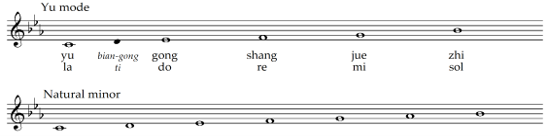
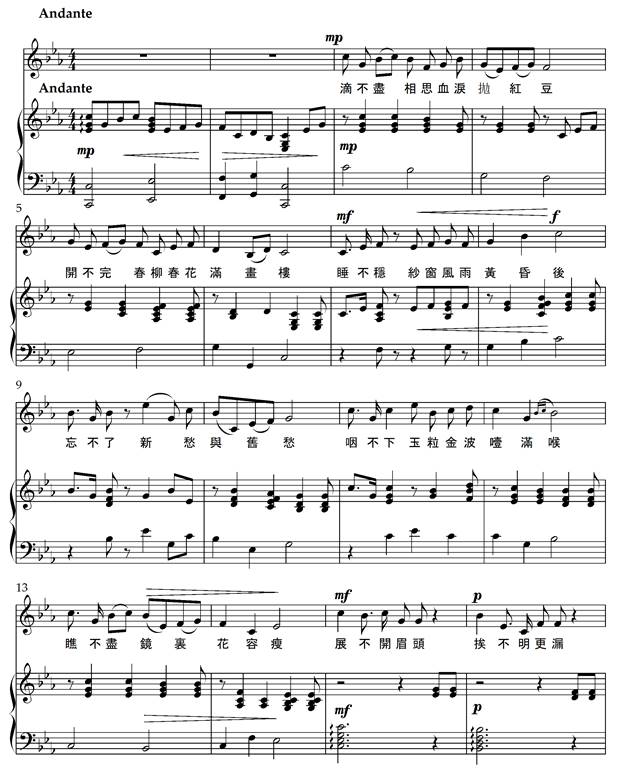
The vocal line in Liu’s setting is in Yu mode 羽調式 (yu-gong-shang-jue-zhi, 羽宮商角徵, la-do-re-mi-sol), comparable to the natural minor scale, with occasional added auxiliary tones—pian yin 偏音, bian gong 變宮 between the first two tones.
The opening four-bar melodic line becomes a recurring thematic figure.

Liu uses dotted rhythm to emphasize the anxiousness reflected in the initial three-word phrases in verses three to six– Shuì bù wěn 睡不穩, wàng bù liǎo 忘不了, yàn bú xià 嚥不下, qiáo bú jìn 瞧不盡.
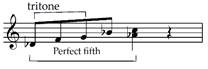
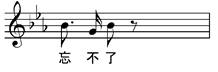
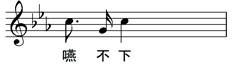
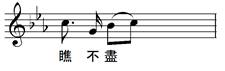
The rhythmic pattern changes for the following couplet.

The longer initial notes manifest the unyielding suffering while the repeating-note endings mimic the sounds of a water clock or night watches.[5]
The melodic line unfolds in small intervals mostly. Two large downward movements take place in mm. 12 and 13. They are rhetorical gestures for the “new and old sorrows” in the text. Portamenti will be appropriate in delivering these musical sighs.
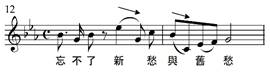
The piano accompaniment is uncomplicated but well designed:
- The upper voices complement the vocal line, often in parallel motion.
- Tonally, it maintains the pentatonic character. Most noteworthy is the descending bass line which accompanies the thematic pattern.
- Western traditional cadences are used to punctuate phrases.
- Frequent appearances of syncopations enhance the restless feelings in the texts.
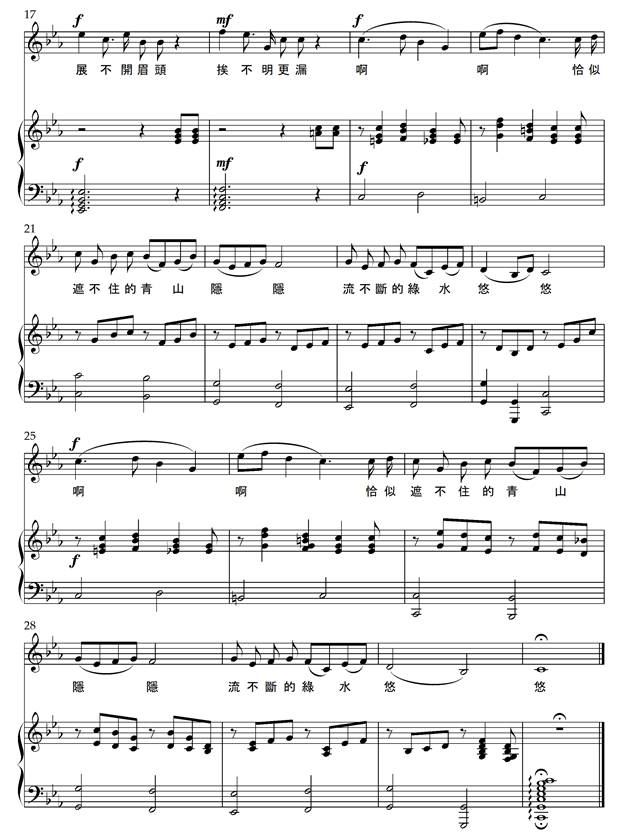
A different version of accompaniment by Sang Tong (1923-2011), included in the third volume of the Centennial Collection of Chinese Art Songs 中國藝術歌曲百年曲集, has become popular in the last decades.[6] The craftmanship and the beauty of this accompaniment deserve a discussion of its own.
[1]玉粒金波 appears as 玉粒金蒓 or 玉粒金蓴 in some literary sources. 蒓/蓴, [chùn] ㄔㄨㄣˊ, water plant.
[2] The title page of Yu Lei (Shanghai, Mingshan Bookstore 名山書局, 1946) reads: Original work by Cáo Xuěqín 曹雪芹原著; Adaptation by Zhu Tong 朱彤改作. Zhu later argued that his play was influence by Cáo’s novel but was not a retelling of the story. Ibid., 142-146.
Yu Lei 郁雷.pdf_Wiki Commons
[3] On May 20, 1948, Zhou Xiaoyan 周小燕 recorded Liu’s setting for Pathé Record.
Zhou Xiaoyan_Hongdou ci_YouTube
[4] https://goldfishodyssey.com/2021/11/03/chinese-poetry-xiv-verses-of-red-beans/
[5] Geng 更is a time measurement, equal to two hours. Geng lou更漏 is a slow-dripping water clock. In ancient time, village watchmen would patrol the streets beating the gong or clappers to call out the time at night.
[6] Liao Changyong 廖昌永 ed., Zhongguo yishu ghequ bainianquji, di san ji—zhengrongsuiyue (中國藝術歌曲百年曲集,第三集—崢嶸歲月, Collection of Chinese Art Songs in 100 years, volume 3), Shanghai Conservatory of Music Press, 2020. In the edition for high voices, Hongdu ci arranged by Sang Tong is found from page 107 to page 109.