Air of Weicheng/Send-off for Yuan’er on his mission to Anxi
渭城曲/送元二使安西
Wang Wei 王維
渭城朝雨浥輕塵
[wei4 cheng2 zhao1 yu3 yì4 qing1 chen2]
ㄨㄟˋ ㄔㄥˊ ㄓㄠˉ ㄩˇ ㄧˋ ㄑㄧㄥˉ ㄔㄣˊ
Mists, after the morning rain in Weicheng, dampened the light dust.
客舍青青柳色新
[kè4 shè4 qing1 qing1 liu3 sè4 xin1]
ㄎㄜˋ ㄕㄜˋ ㄑㄧㄥˉ ㄑㄧㄥˉ ㄌㄧㄡˇ ㄙㄜˋ ㄒㄧㄣˉ
The guest house is irradiated by verdant willows, all pristine.
勸君更盡一杯酒
[quan4 jun1 geng4 jin4 yì4 bei1 jiu3]
ㄑㄩㄢˋ ㄐㄩㄣˉ ㄍㄥˋ ㄐㄧㄣˋ ㄧˋ ㄅㄟˉ ㄐㄧㄡˇ
I urge you, my friend, to drain another cup of wine:
西出陽關無故人
[xi1 chu1 yang2 guan1 wu2 gu4 ren2]
ㄒㄧˉ ㄔㄨˉ ㄧㄤˊ ㄍㄨㄢˉ ㄨˊ ㄍㄨˋ ㄖㄣˊ
For west of Yangguan, you will find no old friends.
__Yangguan san dié 陽關三疊, qinge 琴歌
Since ancient time, qin 琴 (or guqin 古琴—ancient qin) , a fret-less plucked seven-string instrument, has been a symbol of spiritual and cultural refinement for Chinese scholars. Among qin repertoire, pieces to be played and sung by the players in a heterophonic manner are called qinge 琴歌 (qin-song). Yangguan san dié 陽關三疊, one of the most important works in this category, is based on Weicheng qu 渭城曲 (air of Weicheng) by Wang Wei 王維 (699-759). Wang has written the poem as a send-off for an old friend on his way to a remote post. Yangguan 陽關, a frontier pass near Dunhuang symbolizing the geographical and emotional boundaries in the poem, soon becomes the namesake of the qinge. The second part of the title—san dié 三疊, means “three folds” literally. In music, it is often translated as three repetitions.
Su Shi 蘇軾 (1037-1101) of the Song Dynasty in his essay “Ji Yangguan sì sheng 記陽關四聲” (an account of the fourth phrase of Yangguan) documented the performance practices of Yangguan san dié:[1]
舊傳陽關三疊,然今歌者,每句再疊而已,通一首言之,又是四疊。皆非是。或每句三唱,以應三疊之說,則叢然無復節奏。余在密州,有文勛長官,以事至密,自雲得古本陽關,其聲宛轉淒斷,不類向之所聞,每句皆再唱,而第一句不疊。乃知唐本三疊蓋如此。及在黃州,偶讀樂天《對酒》詩云:「相逢且莫推辭醉,新唱陽關第四聲。」註:「第四聲:『勸君更盡一杯酒。』」以此驗之,若第一句疊,則此句為第五聲矣,今為第四聲,則第一不疊審矣。
Three folds of Yangguan were circulated in the old days. Today, however, singers would perform each verse twice only. Taking the entire song into account, there would be four repetitions. Neither would match the “three-fold” tradition. Others sing each verse three times to fit the term “three-folds.” There would be, however, no longer any rhythmic organization. When I was in Mizhou, my superior Wen Xun came for a business visit. He said that he obtained an old version of Yangguan. It sounded melodious and forlorn, unlike what one usually heard. [In which], every verse was repeated except the first one. Hence, I understood that this would have been the three-hold practice of the Tang Dynasty. Also, when I was in Huangzhou, I came across [Bai] Letian’s “Duei jiu”. It read: “As we encounter each other, do not use inebriation as an excuse. Let’s sing the fourth phrase of Yangguan again.” The poet noted: “The fourth phrase is: ‘quan jun geng jin yi bei jiu’” Based on this note, if the first verse were repeated, the quoted verse would have been the fifth phrase. With it being the fourth, the first verse would not have been repeated.[2]
From these commentaries, we can be certain that
- Yangguan san dié was already a popular song in the Tang Dynasty, decades after Wang Wei’s death.
- It was passed down both orally and in written form.[3]
- Structurally and musically, it continued to evolve.
Zhe yin shi zi qin pu 浙音釋字琴譜 (1491), one of the first tablature collections pairing song texts and notes, contains an eight-part version of Yangguan san dié. Only the initial sectionuses Wang Wei’s verses.[4]
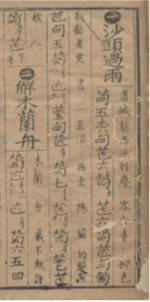
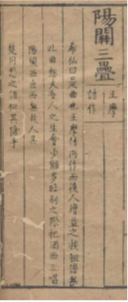
Zhe yin shi zi qin pu 浙音釋字琴譜, Wiki commons, scanned pages 140 (right column)-141 (left)
The opening motif set to the first verse of Weicheng qu becomes a closing refrain in the later sections pairing with the text “wu shan gao song shui dong liu 吳山高聳水東流” (Wu Mountain towering, water flowing eastwards).
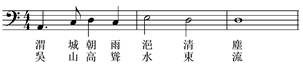
A later version of Yangguan appears in Xin kan fa ming qin pu 新刊發明琴譜 (1530).[5] Largely following the structure in the Zhe yin version with some new texts, it combines the first two parts into one and added a repetition of Weicheng qu as the conclusion.
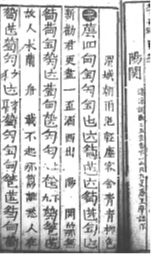
Xin kan fa ming qin pu 新刊發明琴譜, vol. 2, Wiki commons, scanned page 29.
Today’s performances are mostly based on the notation found in Qinxue rumen 琴學入門 (1864).[6] Written and compiled by Zhang Hè 張鶴 as a rudimentary method book, it is divided into two parts: Part one, introduction to the instrument and performance technique; part two, tablature of essential works. Without the pairing of lyrics, this collection added gongche notation 工尺譜 to aid the pitch recognition and the appreciation of rhythmic flow.
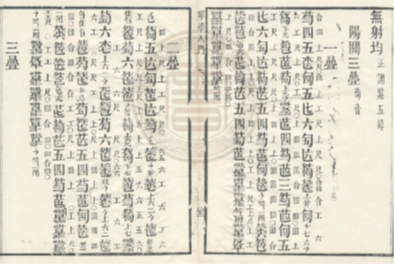
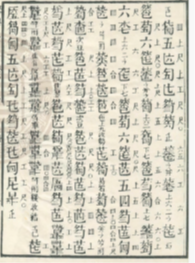
Qinxue rumen 琴學入門 (1864)_ Two parts 二卷_Volume 6, 12 -13 : Tianjin Library, Wiki commons
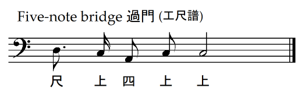
This version of Yangguan consists of three parts with a coda. Each of the main parts begins with a complete statement of Weicheng qu and continues with added melodies and texts.[7] A recurring five-note bridge marks the division of the melodies. In a revised edition of 1873, the complete lyrics along with gongche notation were provided following the qin tablature.[8]
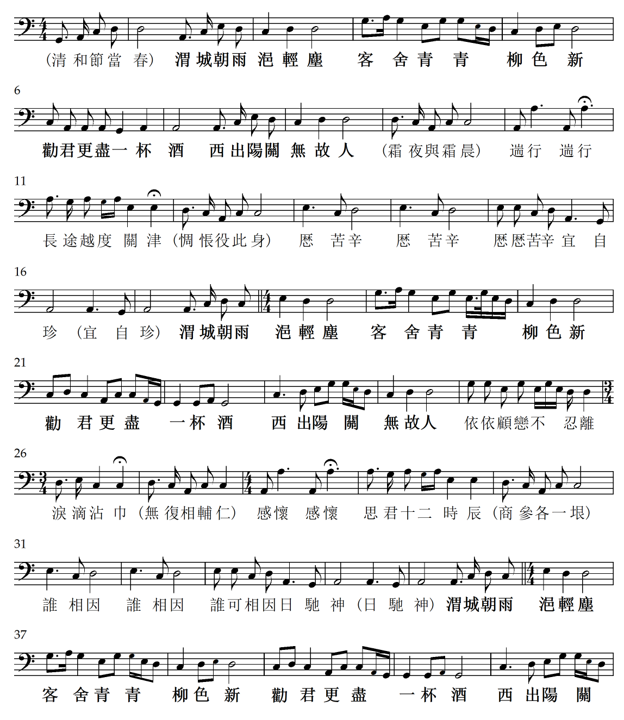
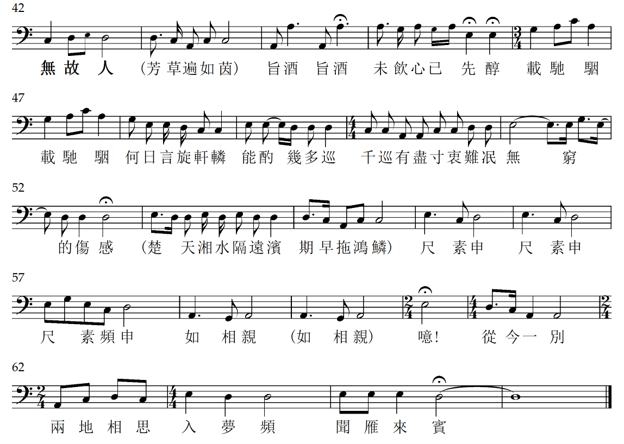
Since oral tradition always plays an important role in the performance practice of Chinese music, characteristic details vary from performer to performer. In 1949, Wang Zhengya 王震亞 adapted the interpretation of Yangguan by the twentieth century virtuoso Xia Yifeng 夏一鋒 into a choral arrangement with piano accompaniment. This arrangement is frequently performed in recitals as a solo art song. Below is a transcription of Yangguan san dié based on Qinxue rumen and interpretations of modern performers. Wang Wei’s verses are presented in bold; additional texts, regular font. The words in parenthesis, mostly pairing with the bridge, were omitted in Wang Zhengya’s choral adaptation.
__Setting of Yangguan san dié by Huang Yongxi 黃永熙 (1917-2003)
Born on July 1, 1917, in Hankou 漢口 of Cantonese heritage, Huang Yongxi grew up in Shanghai where his father owned a construction company. Devoted Christians, the Huangs participated in church choirs and music groups passionately. At age twenty, Huang Yongxi became the director of the church orchestra. He later studied conducting and theory with Theodore Urbach and Stokowski. During the Japanese occupation, he stayed behind and did musical work in the International Settlement.
He left for America in 1947, studying engineering at Bob Jones University. After graduation, he settled in New York and continued pursuing musical studies while working as an engineer. For three summers, he trained with renowned conductor Pierre Monteux. In 1961, he received a Ph.D. in Music Education at Columbia University. Six years later, he gave up a successful career in engineering and returned to Hong Kong, dedicating his time and effort on church music. As an art-song composer, Huang rendered works with melodious vocal lines and eloquent piano accompaniment.
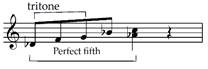
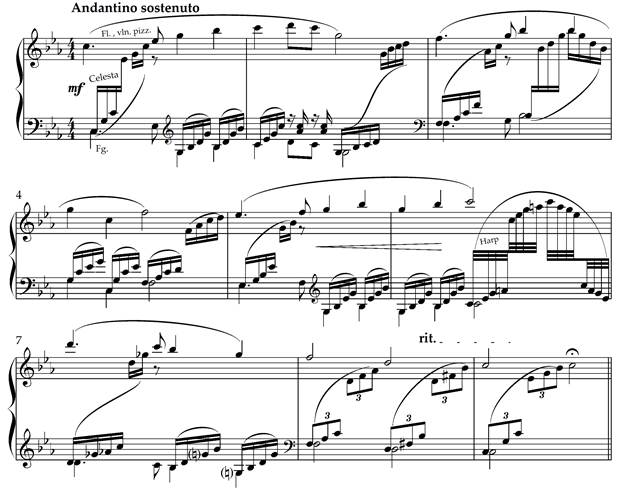
His setting of Yangguan san dié begins with an extended piano solo carrying the entire melody, which would be repeated three times. Throughout the introduction, the melodic line is doubled in the soprano and the bass, as two voices sing in unison. Arpeggios derive from the melodic notes flow in between the voices without a “functional” structure. Dissonant intervals in mm. 6 to 8 are clearly symbols of intoxication and parting sorrows.
__ 一疊 (The first fold)
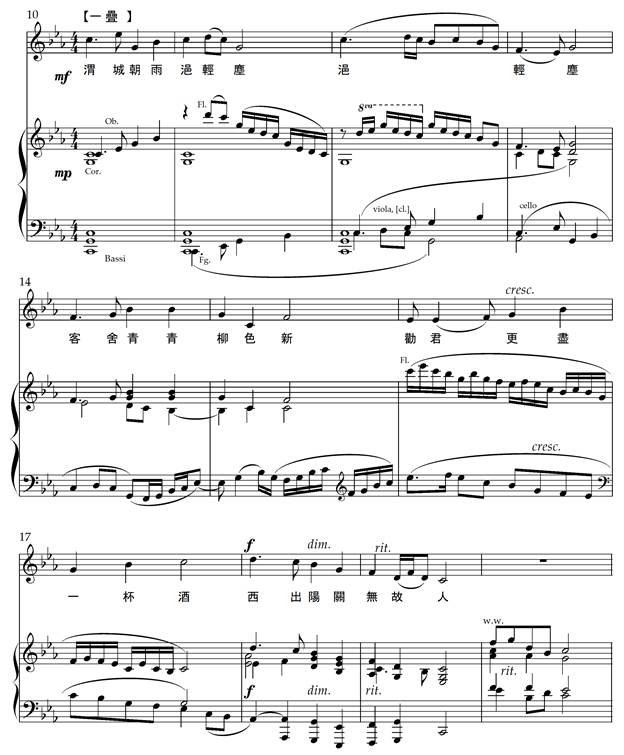
In the first repetition, the last three words of verse one—yì qing chen 浥輕塵 (dampened the light dust)—are sung twice: the second time, in a melismatic manner. The two-bar melody for verse one turns into a four-part imitation in the piano accompaniment, which continues polyphonically. The section ends on a fully functional authentic cadence in m. 19.
__ 二疊 (The second fold)
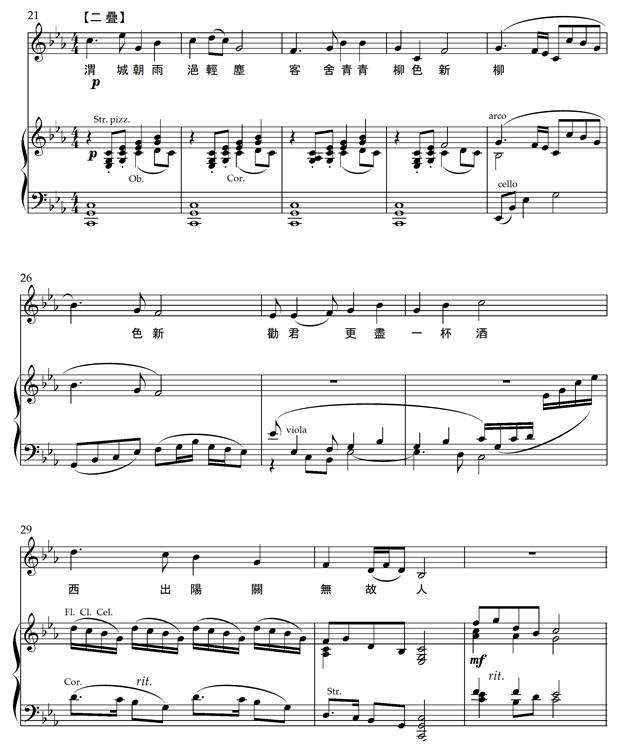
In the second fold, the last three words of verse two—liu sè xin 柳色新 (irradiated by verdant willows)—are repeated, with the second time being a melismatic variation (mm. 25-26) which moves along with the piano line like the weeping willow. The piano part opens with an ostinato consisting of a sustained open c chord in the left hand and staccato chords in the right hand. The three-note motif c-d-c, taken from the second measure of the vocal part, is repeated in the middle voice. Polyphonic texture returns in m. 25 and culminates in m. 29 where the same motif is layered in three different note values, emphasizing the words xi chu yang guan (west of Yangguan). A downward cadential movement gives a heart-broken ending.
__ 三疊 (The third fold)
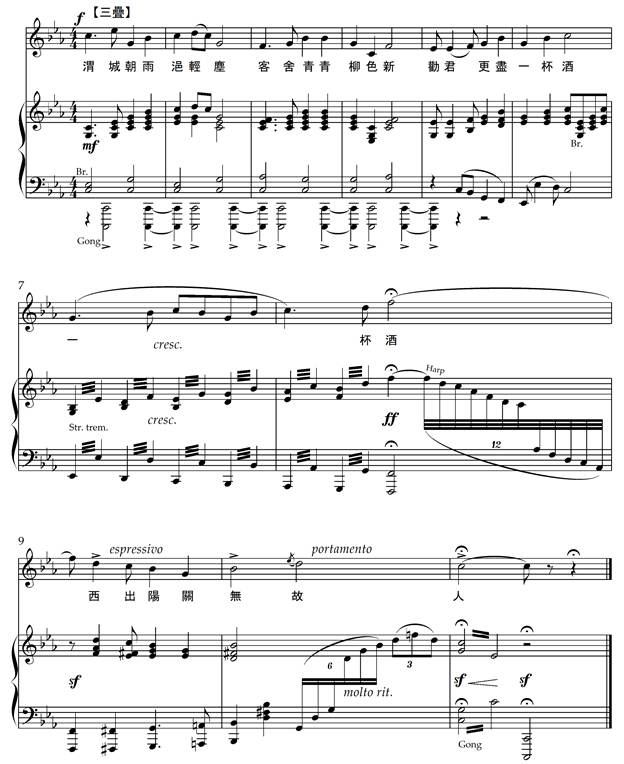
In the third fold, the final three words of verse three—yì bei jiu 一杯酒 (another cup of wine) are repeated. The piano accompaniment becomes dramatic with solid chords and syncopated lower parts, extending to the lowest register of the instrument. The low c octaves are marked with “gong.” The second statement of yì bei jiu is intensified by the buildup of tremolo. The dissonances in the piano introduction recur in the last verse.
In Zhongguo yishu ge baiquji 中國藝術歌百曲集 (Collection of one hundred Chinese art songs) of 1975, orchestration shorthand was given throughout the entire song.[9] These markings reflect the composer’s ideas for tone colors and articulations as well as the possibility of an orchestrated version of the setting. Performers, especially pianists, should take these markings into consideration while preparing the work.
Words of sadness are not found in Wang Wei’s Weicheng qu. The profoundness of emotions, nevertheless, is palpable. These verses have become the embodiment of parting sorrows in the Chinese psyche over the centuries. Saying farewell once is never enough. Thus, let the words and songs be repeated once, twice and more times.
[1] 三蘇全集_第三十九册_Wiki common, scanned page 3.
[2] The verses are taken from the fourth of five seven-word jueju on wine, “Duei jiu wu shou 對酒五首,” by Bai Letian (Juyi) 白樂天 (居易).
[3] Traditional guqin tablature, jianzi pu (減字譜), uses symbols combining elements of characters to indicate the playing technique and the position of the string.
Guqin_notation_Wiki, https://blog.nyl.io/guqin-part-3-tablature-old-and-new/
[4] 浙音釋字琴譜_朱權原題臞仙_刻本_Wiki common, scanned page 140-143. The last section is incomplete.
See www.silkqin.com/02qnpu/09zysz/zy13ygsd.htm#music for details on this version of Yangguan san dié including the complete texts and performance notes. A transcription and performance by John Thompson can be found at https://www.silkqin.com/07play/staff/1505/revzy13ygsd.pdf and
https://www.silkqin.com/06hear/myrec/1505/zy13ygsd.mp3
[5] 新刊發明琴譜_第2冊_Wiki common, scanned pages 29-34.
[6] Many contemporary sources cited the date 1867. A preface by the compiler Zhang Hè 張鶴 was dated the third year of Tongzhi 同治三年 (1864).
琴學入門_二卷_第1冊_Wiki common, scanned page 4.
[7] 琴學入門_二卷_第6冊_Wiki common, scanned pages 12-13.
Yangguan san dié, played and sung by Hu Ruyin 胡如茵_YouTube.
[8] Texts on the first page of Part two indicated that the collection was revised in Tongzhi kweiyo 同治癸酉 (1873) by Li Shifang 李士芳. 琴學入門二卷_清張鶴輯_清陸琮校刊_清李士芳重較_清吳嗣昭訂_清光緒刻本_Wiki common, scanned pages 83-88.
[9] Liang Rongling 梁榮嶺, ed., Zhongguo yisu ge baiquji 中國藝術歌百曲集 (Collection of one hundred Chinese art songs), Taipei, Tiantong Publication 天同出版社, 1975, 73-75.