- Finding a voice: Chinese art songs
- Two rivers and a wall (I): The Yellow River 黃河
- Two rivers and a wall (II): The Yangtze River 長江
- Two rivers and a wall (III): The Great Wall 萬里長城
- All about Confucius
- Chinese Poetry (I): Classic of Poetry 詩經
- Chinese Poetry (II): More about “Guanju”
- Chinese Poetry (III): Songs of Chu 楚辭
- Chinese Poetry (IV): “Song of the Yue Boatman” 越人歌
- Chinese Poetry (V): Han and Jian’an
- Chinese Poetry (VI): Transition and transformation
- Chinese Poetry (VII): Tang poetry
- Chinese Poetry (VIII): Three Refrains of Yangguan 陽關三疊
- Chinese Poetry (IX): Ci—Lyric verses
- Chinese Poetry (X): The Great River Flows Eastwards 大江東去
- Chinese Poetry (XI): Autumn Sentiments 聲聲慢
- Chinese Poetry (XII): A Love Song 卜算子
- Chinese Poetry (XIII): Turning Point
- Chinese Poetry (XIV): Verses of Red Beans 紅豆詞
- Chinese Poetry (XV): Revolutions
- Chinese Poetry (XVI): How Can I Help but Think of Her? 教我如何不想她
- Chinese Poetry (XVII): Chance Encounter 偶然
- Musical Settings (I): Introduction
- Musical Settings (II): Words, Tones and Music
- Musical Settings (III): Diction
- Musical Settings (IV): “The Great River Flows Eastwards,” The Song
- Musical Settings (V): “I Live Near the Headwaters of the Long River,” The Song
- Musical Settings (VI): Xiao Youmei 蕭友梅 and Yi Weizhai 易韋齋
- Musical Settings (VII): “Questions” 問
- Musical Settings (VIII): “How Can I Help but Think of Her,” The Song
- Musical Settings (IX): “Listening to the Rain” 聽雨
- Musical Settings (X): “Bouquets in the Vase” 瓶花
- Musical Settings (XI): “Not a Flower” 花非花
- Musical Settings (XII)— “In the Mountains” 山中
- Musical Settings (XIII): “Chance Encounter” 偶然
- Musical Settings (XIV): Art Songs and Patriotism
- Musical Settings (XV): “By the Songhua River” 松花江上
- Musical Settings (XVI): “Ballad of the Great Wall” 長城謠
- Musical Settings (XVII): “Hometown Beyond the White Clouds” 白雲故鄉
- Musical Settings (XVIII): “By the Jialing River” 嘉陵江上
- Musical Settings (XIX): “Verses of Red Beans” 紅豆詞, Liu Xue’an 劉雪庵
- Musical Settings (XX): Sang Tong’s Accompaniment for Hongdou ci
- Musical Settings (XXI): “Yangguan san dié” 陽關三疊
By the Jialing River 嘉陵江上
Words by Duanmu Hongliang 端木蕻良
那一天,敵人打到了我的村莊,
[na4 yi4 tian1 di2 ren2 da3 dao4 le5 wo3 de5 cun1 zhuang1]
ㄋㄚˋ ㄧˋ ㄊㄧㄢˉ ㄉㄧˊ ㄖㄣˊ ㄉㄚˇ ㄉㄠˋ ㄌㄜ˙ ㄨㄛˇ ㄉㄜ˙ ㄘㄨㄣˉ ㄓㄨㄤˉ
On that day, when the enemies attacked my village,
我便失去了我的田舍、家人和牛羊。
[wo3 bian4 shi1 qu4 le5 wo3 de5 tian2 she4 jia1 ren2 he2 niu2 yang2]
ㄨㄛˇ ㄅㄧㄢˋ ㄕˉ ㄑㄩˋ ㄌㄜ˙ ㄨㄛˇ ㄉㄜ˙ ㄊㄧㄢˊ ㄕㄜˋ ㄐㄧㄚˉ ㄖㄣˊ ㄏㄜˊ ㄋㄧㄡˊ ㄧㄤˊ
I lost my farmhouse, family, cattle and sheep.
如今我徘徊在嘉陵江上,
[ru2 jin1 wo3 pai2 huai2 zai4 jia1 ling2 jiang1 shang4]
ㄖㄨˊ ㄐㄧㄣˉ ㄨㄛˇ ㄆㄞˊ ㄏㄨㄞˊ ㄗㄞˋ ㄐㄧㄚˉ ㄌㄧㄥˊ ㄐㄧㄤˉ ㄕㄤˋ
Now wandering by the Jialing River,
我仿佛聞到故鄉泥土的芳香,
[wo3 fang3 fu2 wen2 dao4 gu4 xiang1 ni2 tu3 de5 fang1 xiang1]
ㄨㄛˇ ㄈㄤˇ ㄈㄨˊㄨㄣˊ ㄉㄠˋ ㄍㄨˋ ㄒㄧㄤˉ ㄋㄧˊ ㄊㄨˇ ㄉㄜ˙ ㄈㄤˉㄒㄧㄤˉ
I smell, seemingly, the fragrance of the hometown soil
一樣的流水,一樣的月亮,
[yi2 yang4 de5 liu2 shui3 yi2 yang4 de5 yue4 liang4]
ㄧˊ ㄧㄤˋ ㄉㄜ˙ ㄌㄧㄡˊ ㄕㄨㄟˇ ㄧˊ ㄧㄤˋ ㄉㄜ˙ ㄩㄝˋ ㄌㄧㄤˋ
Water flows persistently; moon shines unperturbed;
我已失去了一切歡笑和夢想
[wo3 yi3 shi1 qu4 le5 yi2 qie4 huan1 xiao4 he2 meng4 xiang3]
ㄨㄛˇ ㄧˇ ㄕˉ ㄑㄩˋ ㄌㄜ˙ ㄧˊ ㄑㄧㄝˋㄏㄨㄢˉㄒㄧㄠˋ ㄏㄜˊ ㄇㄥˋ ㄒㄧㄤˇ
I have lost all the joy and dreams.
江水每夜嗚咽地流過,
[jiang1 shui3 mei3 yie4 wu1 yie4 di5 liu2 guo4]
ㄐㄧㄤˉ ㄕㄨㄟˇ ㄇㄟˇ ㄧㄝˋ ㄨˉ ㄧㄝˋ ㄉㄧ˙ ㄌㄧㄡˊ ㄍㄨㄛˋ
River flows by sobbing nightly,
都仿佛流在我的心上。
[dou1 fang3 fu2 liu2 zai4 wo3 de5 xin1 shang4]
ㄉㄡˉ ㄈㄤˇ ㄈㄨˊ ㄌㄧㄡˊ ㄗㄞˋ ㄨㄛˇ ㄉㄜ˙ ㄒㄧㄣˉ ㄕㄤˋ
As if it was tearing over my heart.
我必須回到我的家鄉,
[wo3 bi4 xu1 hui2 dao4 wo3 de5 jia1 xiang1]
ㄨㄛˇ ㄅㄧˋ ㄒㄩˉ ㄏㄨㄟˊ ㄉㄠˋ ㄨㄛˇ ㄉㄜ˙ ㄐㄧㄚˉ ㄒㄧㄤˉ
I must return to my hometown,
為了那没有收割的菜花,
[wei4 le5 na4 mei2 you3 shou1 ge1 de5 cai4 hua1]
ㄨㄟˋ ㄌㄜ˙ ㄋㄚˋ ㄇㄟˊ ㄧㄡˇ ㄕㄡˉ ㄍㄜˉㄉㄜ˙ ㄘㄞˋㄏㄨㄚˉ
For the unharvested vegetable crops,
和那餓瘦了的羔羊。
[he2 na4 e4 shou4 le5 de5 gao1 yang2]
ㄏㄜˊ ㄋㄚˋ ㄜˋ ㄕㄡˋ ㄌㄜ˙ ㄉㄜ˙ ㄍㄠˉ ㄧㄤˊ
For the emaciated lambs.
我必須回去,
[wo3 bi4 xu1 hui2 qu4]
ㄨㄛˇ ㄅㄧˋ ㄒㄩˉ ㄏㄨㄟˊ ㄑㄩˋ
I must return,
從敵人的槍彈底下回去。
[cong2 di2 ren2 de5 qiang1 dan4 di3 xia4 hui2 qu4]
ㄘㄨㄥˊ ㄉㄧˊ ㄖㄣˊ ㄉㄜ˙ ㄑㄧㄤˉ ㄉㄢˋ ㄉㄧˇ ㄒㄧㄚˋ ㄏㄨㄟˊ ㄑㄩˋ
From underneath the enemies’ bullets.
我必需回去,
[wo3 bi4 xu1 hui2 qu4]
ㄨㄛˇ ㄅㄧˋ ㄒㄩˉ ㄏㄨㄟˊ ㄑㄩˋ
I must return,
從敵人的刺刀叢里回去。
[cong2 di2 ren2 de5 ci4 dao1 cong2 li3 hui2 qu4]
ㄘㄨㄥˊ ㄉㄧˊ ㄖㄣˊ ㄉㄜ˙ ㄘˋ ㄉㄠˉ ㄘㄨㄥˊ ㄌㄧˇㄏㄨㄟˊ ㄑㄩˋ
From the midst of the enemies’ bayonets.
把我那打勝仗的刀槍,
[ba3 wo3 na4 da3 sheng4 zhang4 de5 dao1 qiang1]
ㄅㄚˇ ㄨㄛˇ ㄋㄚˋ ㄉㄚˇ ㄕㄥˋ ㄓㄤˋ ㄉㄜ˙ ㄉㄠˉ ㄑㄧㄤˉ
Placing my weapons of victory
放在我生長的地方。
[fang4 zai4 wo3 sheng1 zhang3 de5 di4 fang1]
ㄈㄤˋ ㄗㄞˋ ㄨㄛˇ ㄕㄥˉ ㄓㄤˇ ㄉㄜ˙ ㄉㄧˋ ㄈㄤˉ
Where I came of age.
__Jialing River 嘉陵江
The Jialing River is a major tributary of the Yangtze River. Its eastern source originates from the southern slope of the Qin Mountains 秦嶺 near Feng County 鳳縣 of Shaanxi Province 陝西省.[1]
Its namesake Jialing 嘉陵, the Imperial tomb of King Jia, was once located in the region.[2] Flowing southwestwards, it meets one of its major tributaries Xihan River (西漢水, West Han River) in Lueyang County 略陽縣.[3] Soon after entering the Sichuan Province, it converges with Bailong River 白龍江,[4] its longest tributary, in Guangyuan City 廣元市 before continuing southward and draining into the Yangtze River in Chongqing.
The beauty of the Jialing River is legendary: In Tangchao minghua lu (唐朝名畫錄, Records of Famous Paintings of the Tang Dynasty, c. 840-846 AD), art critic Zhu Jingxuan 朱景玄 stated that during the Tianbao Era 天寶年間 (742-756), Emperor Xuanzong of the Tang Dynasty 唐玄宗 sent artist Wu Dauzi 吳道子to explore the scenery of the Sichuan Basin. It was said that, upon his return, Wu completed the mural “Three Hundred Li[5] of Jialing River Landscape” 嘉陵江山水三百里freehanded on the walls of Tatong Palace 大同殿 within a day.[6]
In Shaanxi, the headwaters of the Jialing River are located inside the Tiantai Mountains National Forest Park 寶雞天台山國家森林公園. Langmusi 郎木寺 near the border of Gansu and Sichuan provinces where the Bailong River originates, is an important monastery compound of the Gelug School of Tibetan Buddhism.[7] Before merging with the Yangtze River in the urban center of Chongqing, the Jialing River passes three gorges—Libi Gorge 濿鼻峽, Wentang Gorge 溫塘峽 and Guanyin Gorge 觀音峽—between Hechuan 合川 and Beibèi 北碚 Districts. The magnificence of this seventeen-mile stretch landscape earns it the name of Jialingjiang Xiaosanxia (嘉陵江小三峽, Three little gorges on the Jialing River), comparable to the Three Gorges of the Yangtze River.[8]
In December 1937, Chongqing became the wartime capital of the KMT government. The Executive Branch and administrative bureaus were situated in the Beibei District. During the same period, Fudan University 復旦大學 evacuated from Shanghai and relocated in Xiaba 夏壩 on the opposite bank of Beibèi. The stunning scenery and the elite culture of Beibèi formed the backdrop of Duanmu Hongliang’s verses Jialing jiang shang 嘉陵江上.
__Duanmu Hongliang 端木蕻良 (1912-1996)[9]
Born Cao Hanwen 曹漢文[10] into a prominent family of Manchu ethnicity in Changtu County 昌圖 of Liaoning Province 遼寧省[11], Duanmu Hongliang was a member of the Chinese Northeast Writers Group 東北作家群.[12] Fleeing from their hometown in the northeastern provinces—Manchuria—to avoid Japanese persecution, these young writers were active in the Central Plain region during the 1930s. Their works reflected the oppression of the Japanese invaders, the suffering of people during the war, and nostalgia for their homeland. The other commonality among the works by these writers was the left-leaning ideology.[13]
In 1928, Duanmu was sent to the elite preparatory school Naikai High school in Tianjin 天津市南開中學.[14] After the 9-1-8 incident, he began organizing Kangri Jukuo Tuan 抗日救國團 (Anti-Japanese Nation Salvation Group) and was expelled from the school. In 1932, he entered the history department of Qinghua University and joined the League of Left-Wing Writers 中國左翼作家聯盟.[15] As the editor of the journal for the League, he established a relationship with the famed author Lu Xun 魯迅. Under Lu’s mentorship, in 1933, he began writing the epic novel The Grassland of the Khorchin Banner《科爾沁旗草原》about a family’s life in Inner Mongolia under the Russian and Japanese oppressions.[16] Although the work, completed in 1935, was not published until 1939, its exquisite depictions of scenery and vivid delivery of characters firmly solidified Duanmu’s literary place among his peers.[17]
After a stint in Shanghai (1936-1937), Duanmu moved to Wuhan 武漢 and married his fellow writer Xiao Hong 蕭紅 in May 1938. They taught at the National Revolutionary University 民族革命大學 in Linfen City 臨汾, Shanxi Province 山西省 from spring to autumn of 1938. Subsequently, Duanmu joined the faculty of Fudan University in Beibèi in the winter of 1938 and remained in Chongqing until early 1940, when he relocated to Hong Kong.[18] Following the Japanese invasion of Hong Kong and the death of Xiao Hong on January 22, 1942, Duanmu found refuge in Guilin 桂林 before continuing his activities in Chongqing, Shanghai and Hong Kong in the 1940s.[19]
In addition to voluminous prose and long-form works, Duanmu Hongliang’s most significant literary contribution in his later years was Cao Xueqin 《曹雪芹》, a biographical fiction on the author of the monumental Dream of the Red Chamber. It reflected his passion for the Red Chamber and his desire to complete Cao’s unfinished work.[20] Duanmu was also an active member of writers’ organizations, such as PEN International 國際筆會, Beijing Writers Association北京作家協會, and China Writers Association 中國作家協會. He passed away in Beijing in 1996.
__Hè Luting[21] 賀綠汀 (1903-1999)
Hè Luting was born in Shaoyang County 邵陽縣 (today’s Shaodong City 邵東市) of Hunan Province 湖南省 in 1903.[22] His artistic life initiated in the spring of 1923 when he entered Yueyun High School 岳雲中學, studying fine art and music. After graduating in 1926, he became a teacher at Yueyun and joined the Chinese Communist Party. In December 1927, he participated in the failed CCP Uprising in Guangzhou.
In 1931, Hè Luting was accepted at the National Conservatory of Music where he studied composition with Huang Zi 黃自.[23] Russian pianist/composer Alexander Tcherpin 齊爾品 came to Shanghai in 1934 and held a competition, searching for piano works with Chinese characters. Hè won the first prize with his submission “Mutong duandi” (牧童短笛, Shepherd’s piccolo) and was awarded the opportunity to study abroad and a scholarship of 100 Yuan.[24] Soon, following the footstep of Huang Zi, he joined the film industry, leading the music department of Mingxing Film Compony 明星影片公司.[25] His best-known film compositions are “Sìjì ge” (四季歌, Song of the four seasons) and “Tianyá genu” (天涯歌女, The wandering songstress), both for the 1937 film Street Angel 馬路天使.[26]
After the Japanese occupation of Shanghai, Hè first went to Wuhan, working for the China Motion Picture Studio 中國電影製片廠, a government-operated studio responsible for producing anti-Japanese propaganda and documentaries. In August 1938, he moved to Chongqing, heading the music department of the Central Broadcasting System 中央廣播電台[27] and teaching music at Yuzai School 育才學校.
Post WWII, Hè was active in Yan’an and the Northeast. In 1949, he became the Chair of the Music Department at Beijing Normal University and was involved in the preparation for the National Music Conservatory (today’s Central Music Conservatory 中央音樂學院). Later that year, he was appointed Director of Shanghai Music Conservatory, his Alma Mater.
A Chinese version of Monsieur Croche,Debussy’s critical essays on various composers, translated by Zhang Yuhe 張裕禾, appeared in 1963. On May 20, an article written by Yao Wenyuan 姚文元 criticizing Debussy’s view being self-indulgent and anti-proletariat, was published in Wenhui Bao (文匯報, Wenhui Daily).[28] Hè Luting, under the pen name Shan Gu 山谷 , responded with his opinions, discrediting Yao sharply. This exchange stirred up a cycle of arguments on placing political judgements over artistic and literary works. Hè, insisting that criticism of music or literature must be based on thorough understanding of the works, became the target of negative commentaries and landed on the wrong side of the political trend.[29]
Being an artist associated with Western music and a high-ranking administrator, Hè, despite his close relationship with CCP, was blacklisted as an Anti-Party and Anti-Socialism individual at the outset of the Cultural Revolution in June of 1966. Both he and his wife were tortured severely by the Red Guards. Hè was officially arrested on March 21, 1968, and remained in jail until 1973. During these years, he was often humiliated and physically abused in so-called “struggle sessions 批鬥大會.”[30] Some of the struggle sessions were broadcast on TV and led by his former student Yu Huiyong 于會泳. Hè stood his ground.[31] His three daughters, refusing to denounce him, were also persecuted. The second daughter Hè Xiaoqiu 賀曉秋, an up-and-coming composer, eventually took her own life.
By 1979, he was reinstated as the Director of Shanghai Music Conservatory. Five years later, he retired with the title of Honorary Director. He died of pneumonia in 1999.
—Jialing jiang shang
Written shortly after Duanmu Hongliang’s arrival in Chongqing, Jialing jiang shang is a free-form vernacular poem. It can be divided into a few sections: Verses one to four are descriptive—the traditional fù 賦 approach; verses five to eight compare the current state to the old times nostalgically—bǐ 比; verses nine to seventeen are filled with arising energy and determinations—xing 興.[32] Most verses rhyme on [ang] ㄤ, while verse nine to twelve all end on the phrase 回去 [hui2 qu4] ㄏㄨㄟˊ ㄑㄩˋ (return).
The opening phrase of verse five, 一樣的流水—literally, “the same flowing water”—was a figurative expression. Duanmu’s hometown Changtu was not near any major body of water. He was likely comparing Jialing River to Songhua River 松花江, the subject of the popular patriotic song by Zhang Hanhui 張寒暉, which might have been the inspiration for the new poem.
According to an anecdotal account by poet/Journalist Zhang Tianshou 張天授, during a visit by Fang Yin 方殷, a fellow member of the League of Left-Wing Writers, Duanmu commented on Songhua jiang shang, saying that it was worthy of all the enthusiasm but was too despondent. Fang encouraged him to create his own verses with more invigorating spirit. Later, Fang invited Hè Luting to set the newly written verses to music.
Several things are noteworthy in Hè’s musical setting, first published in the inaugural issue of the music journal Yue Feng 樂風 in January 1940:
- Parallel phraseologies between the texts and music: After the eight-bar piano introduction, the vocal line opens with a dramatic leap of a sixth, emphasizing the word tian (天, day) before continuing through the verses in a narrative manner, while the piano, seemingly only punctuating the measures, subtly handles the emotional transitions as the tension of the words rises and falls. The first turning point takes place in m. 18 with a cross-range large leap followed by descending arpeggio in the right-hand part. Where the text moves from remembering the tragic past to realizations of the current moment. As the emotion intensifies, the musical dynamics increase accordingly. Then, in m. 25, with solemn repeating chords, the piano accompaniment leads the vocal lines into a reflective mood for verses five to eight. At the end of this section, in m. 38, the piano part rises up, taking the piece into its final climax.
- Influences from Western vocal traditions: As a whole, the piece has the style of an Italian arioso. Throughout the entire song, the vocal lines, punctuated by the tonic and the dominant, clearly delineate the minor tonality. In the introduction, after an octave call with sustained notes, the piano delivers a descending pattern characteristic of an operatic melisma (mm. 3-4). This pattern recurs in the lower piano part in mm 31-32, where it can be interpreted as the murmuring sound of the river, mentioned in the following line of lyrics. Other rhetorical figures include the melismatic treatment of the word 笑 (laughter) in m. 29 and the short trill in m. 48 on 羔 (lambs), both examples of onomatopoeia.
- The simplicity of the piano accompaniment allows the singer the freedom to punctuate the texts and deliver the emotional details.
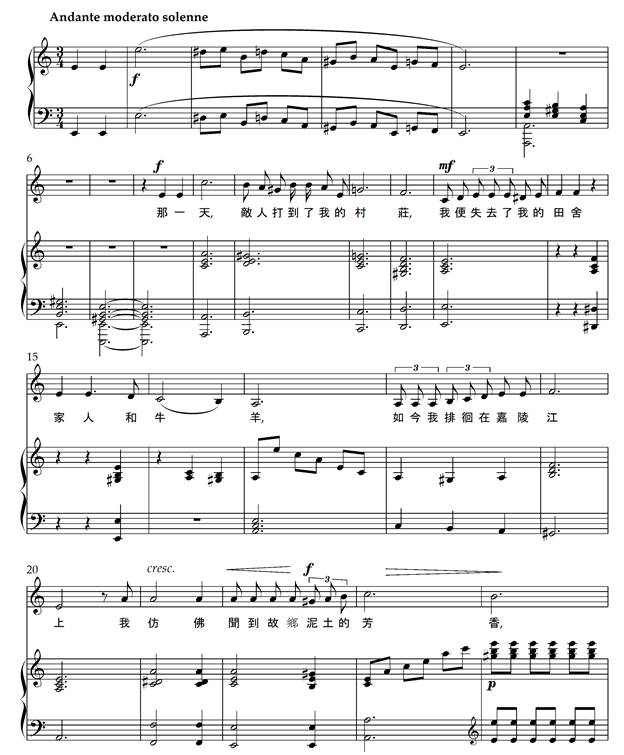
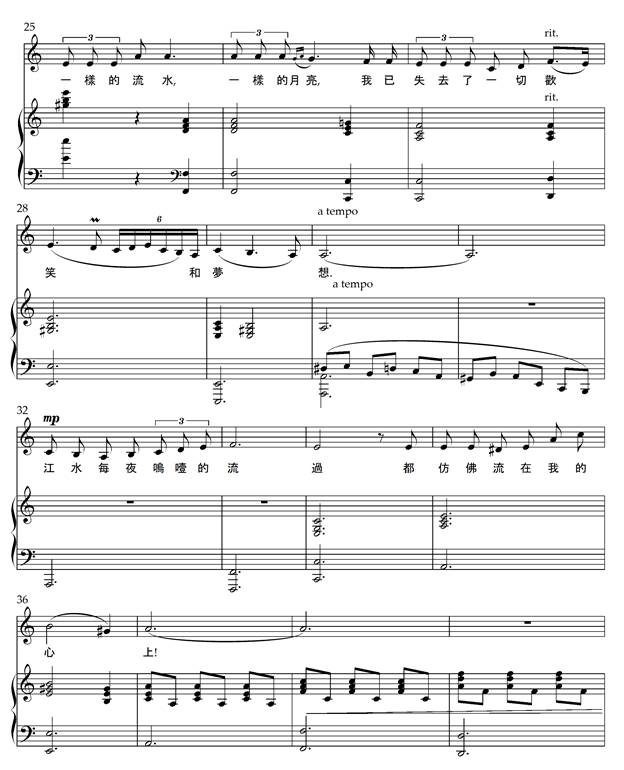
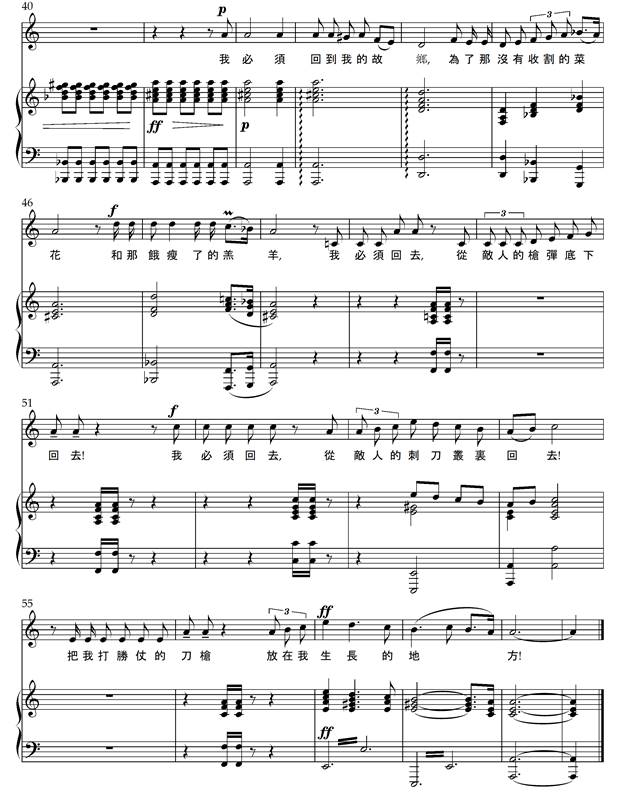
In comparison to Songhua jiang shang, Jialing jiang shang is, technically, a more challenging work for the singer. During the wartime, it never gained the popularity that Songhua jiang shang enjoyed. Nevertheless, it became a staple of recital repertoire in later years. Renowned bass-baritone Sze Yikwei 斯義桂 included the song in his recital at Taipei City Hall 中山堂 in August 1957.[33] It was a rare performance of the piece in Taiwan, which would have been prohibited under martial law for the song’s political lineage. In 2016, baritone Sheng Yang 沈洋 gave his interpretation of Jialing jiang shang in a recital commemorating the first decades of Chinese art songs (1919-1945). The song will likely stand the test of time just like the river.
[1] 嘉陵江水系; Google Map, Jialing River Source
[2] Zhao Jia 趙嘉, aka King Jia of Dai 代王嘉, was the last surviving member of the royal family of the State of Zhao during the Warring State Period. His mausoleum is no longer in existence. A mountain in the region is named Daiwang Shan (代王山, Mountain of King Dai).Jia_of_Zhao_Wiki
[3] The headwaters of Xihan River originate near Li County 禮縣, Gansu Province 甘肅省 from the southwestern slopes of western Qin Mountains. Xihan_river_grokipedia
[4] Bailong River (白龍江, White Dragon River) begins at Langmu Temple 郎木寺 in Zoigê 若爾蓋縣, the northernmost county of the Sichuan Province and a Autonomous Prefecture of Tibetan and Qiang.
Bailong_River_Wiki, Zoigê County_Wiki, 若爾蓋縣_zh.wiki/zh-tw
[5] See Endnote 1 in Musical-settings-xvi-ballad-of-the-great-wall-長城謠_goldfishodyssey.com
[6] Wu_Daozi_Wiki,. 唐朝名畫錄, 中國哲學書電子化計劃_ctext.org
Zhu mentioned that a second painter Li Sixun 李思訓 was also summoned to paint in the palace. Contrary to Wu, Li spent months to achieve realistic details: “. . . 時有李思訓將軍,山水擅名,帝亦宣於大同殿圖,累月方畢。明皇云:「李思訓數月之功,吳道子一日之迹,皆極其妙也。」” Nevertheless, Li died decades earlier in 718.
[7] 郎木寺_zh.wiki , taktsang-lhamo-monastery_mandala.library.virginia.edu
[8] Hechuan,_Chongqing_Wiki, Beibei,_Chongqing_Wiki,
Apple Maps, Jialingjiang Xiaosanxia,
嘉陵江小三峽_baike.baidu.com
[9] 端木 Duanmu is a rare compound (two-character) surname 複姓. Duanmu_Wiki
[10]In 1928, Duanmu changed his name to Cao Jingping 曹京平 for his respect to Warring Stats Period poet Qu Yuan (c. 340 BC – 278 BC). His other noms de plume included Quan Yè 荃葉, Luo Xuan 羅旋, Xin Ren 辛人, Yè Zhilin 葉之琳, Cao Ping 曹坪.
[11] Liaoning was previously known as Fengtian 奉天 and was renamed in 1929.
[12] Chinese_Northeast_Writers_Group_Wiki, 東北作家群_zh.wikipedia.org/zh-tw
[13] https:///The Iron Flood and Its-Manchurian Followers_Rethinking the Northeastern Writers Ggroup in A Global Context_Liu Dong/www.csgc.hku.hk
[14] Tianjin_Nankai_High_School_Wiki
[15] League_of_Left-Wing_Writers_Wiki
[16] Michael Lestz, “Duanmu Hongliang and the Background of ‘Looking for a House,’” Modern Chinese Literature Newsletter 6, no. 1 (1980): 26. http://www.jstor.org/stable/42769651
[17] 阿魯科爾沁旗_zh.wikipedia.org/zh-tw , Banners_of_Inner_Mongolia_Wiki, Ar_Horqin_Banner_Wiki, 科爾沁旗草原.pdf_wikipedia_commons
[18] https://www.chinawriter.com.cn/n1/2020/1119/c404063-31936611.html
This webpage contains an image of a hand-written entry form (c. 1982) for Who’s Who in China 中國名人錄 with a chronological listing of Duanmu’s professional activities.
[19] Lestz, Ibid., 27.
[20] Duanmu’s essays on his interpretation of the Red Chamber are collected and edited by Xu Xuepeng 徐學鵬 in Dream of the Red Chamber: detailed interpretation 細說紅樓夢, edited by (Writers Publishing House 作家出版社, 2006).
[21] The surname 賀 is a fourth-tone word, pronounced with a schwa-sounding vowel and an “h”-sounding consonance: Youtube.com/賀 It is marked /xɤ⁵¹/ in IPA and ㄏㄜˋin Zhuyin. Its pinyin, hè, should not be confused with the English third-person pronoun “he.” 綠, meaning “green,” is usually pronounced lǜ. Here, a less common pronunciation lù is applied.
[22] Hè’s birthname was Anqing 安卿. He also went by Kai 楷 and Baozhen 抱真.
[23] Hè Luting was later known as one of the Four Great Disciples of Huang Zi 黃自四大弟子, along with Chen Tianhe 陳田鶴, Jiang Dingxian 江定仙, and Liu Xue’an 劉雪庵.
[24] Hè submitted three pieces for the competition. With the one prize per person rule, his “Lullaby” was placed an honorary second. Melodically, Mudong duandi is of the character of Chinese folksongs. In simple A-B-A form, its outer sections are in fluent two-part polyphonic imitation. The middle section is with vivid staccato accompaniment.
[25] Mingxing_Wiki
[26] Both songs were based on folk ballades of Suzhou 蘇州. The_Wandering_Songstress_Wiki, Youtube.com/周璇 四季歌, Youtube.com/周璇 天涯歌女
[27] Radio_Taiwan_International#History_Wiki
[28] Yao_Wenyuan_Wiki, Wenhui_Bao_Wiki
[29]monsieur_croche_debussy_archive.org, debussy-changed-scholars-fate_interlude.hk
[30] Struggle_session_Wiki
[31] Yu_Huiyong_Wiki, waou.com.mo/2023/12/21/新華澳報—文革四位帥哥部長的最終結局
[32] Chinese-poetry-i-classic-of-poetry-詩經_goldfishodyssey
[33] Youtube.com/斯義桂 Live in Taipei, 1957