
“Hometown Beyond the White Clouds” 白雲故鄉,
words by Wei Hanzhang 韋瀚章
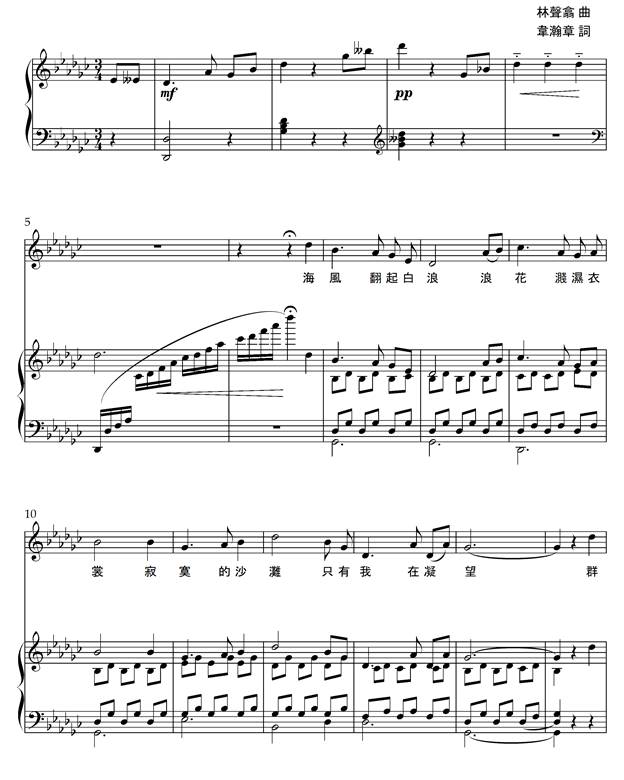
海風翻起白浪,
[hai3 feng1 fan1 qi3 bai2 lang4]
ㄏㄞˇ ㄈㄥˉ ㄈㄢˉ ㄑㄧˇ ㄅㄞˊ ㄌㄤˋ
Sea winds stir up white waves;
浪花濺濕衣裳。
[lang4 hua1 jian4 shi1 yi1 shang5]
ㄌㄤˋ ㄏㄨㄚˉ ㄐㄧㄢˋ ㄕˉ ㄧˉ ㄕㄤ˙
Splashing waves wet my clothes.
寂寞的沙灘,
[ji2 muo4 di5 sha1 tan1]
ㄐㄧˊ ㄇㄛˋ ㄉㄧ˙ ㄕㄚˉ ㄊㄢˉ
On the lonely sandy beaches,
只有我在凝望。
[zhi3 you3 wo3 zai4 ning2 wang4]
ㄓˇ ㄧㄡˇ ㄨㄛˇ ㄗㄞˋ ㄋㄧㄥˊ ㄨㄤˋ
Only I stand gazing.
群山浮在海上,
[qun2 shan1 fu2 zai4 hai3 shang4]
ㄑㄩㄣˊ ㄕㄢˉ ㄈㄨˊ ㄗㄞˋ ㄏㄞˇ ㄕㄤˋ
Mountains float above the ocean;
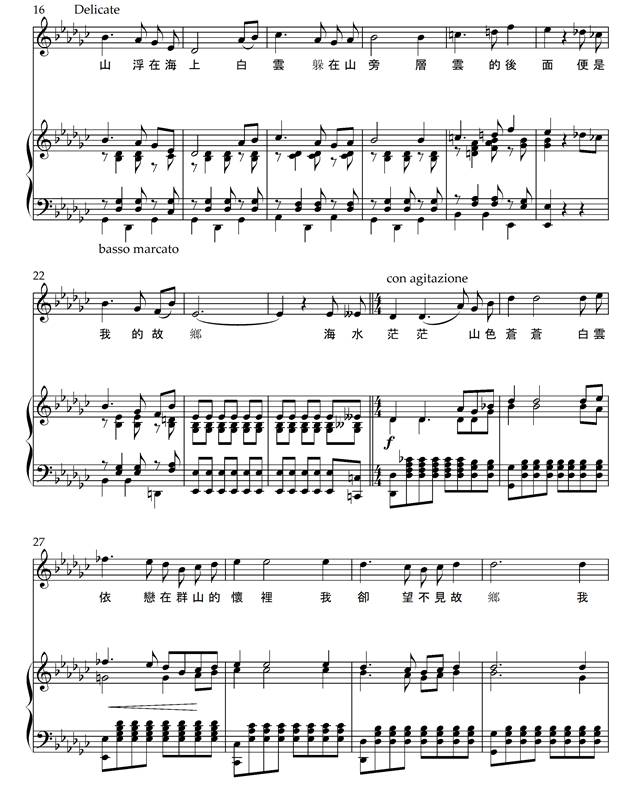
白雲躲在山旁。
[bai2 yun2 duo3 zai4 shan1 pang2]
ㄅㄞˊ ㄩㄣˊ ㄉㄨㄛˇ ㄗㄞˋ ㄕㄢˉ ㄆㄤˊ
White clouds hide behind the mountains.
層雲的後面,
[ceng2 yun2 di5 hou4 mian4]
ㄘㄥˊ ㄩㄣˊ ㄉㄧ˙ ㄏㄡˋ ㄇㄧㄢˋ
Right behind layers of clouds,
便是我的故鄉。
[bian4 shi4 wo3 di5 gu4 xiang1]
ㄅㄧㄢˋ ㄕˋ ㄨㄛˇ ㄉㄧ˙ ㄍㄨˋ ㄒㄧㄤˉ
Is my hometown.
**********
海水茫茫,
[hai3 shui3 mang2 mang2]
ㄏㄞˇ ㄕㄨㄟˇ ㄇㄤˊ ㄇㄤˊ
Boundless ocean,
山色蒼蒼,
[shan1 se4 cang1 cang1]
ㄕㄢˉ ㄙㄜˋ ㄘㄤˉ ㄘㄤˉ
Luxuriant mountains,
白雲依戀在群山的懷裡,
[bai2 yun2 yi1 lian4 zai4 qun2 shan1 di5 huai2 li3]
ㄅㄞˊ ㄩㄣˊ ㄧˉ ㄌㄧㄢˋ ㄗㄞˋ ㄑㄩㄣˊ ㄕㄢˉ ㄉㄧ˙ ㄏㄨㄞˊ ㄌㄧˇ
White clouds still cling to mountains,
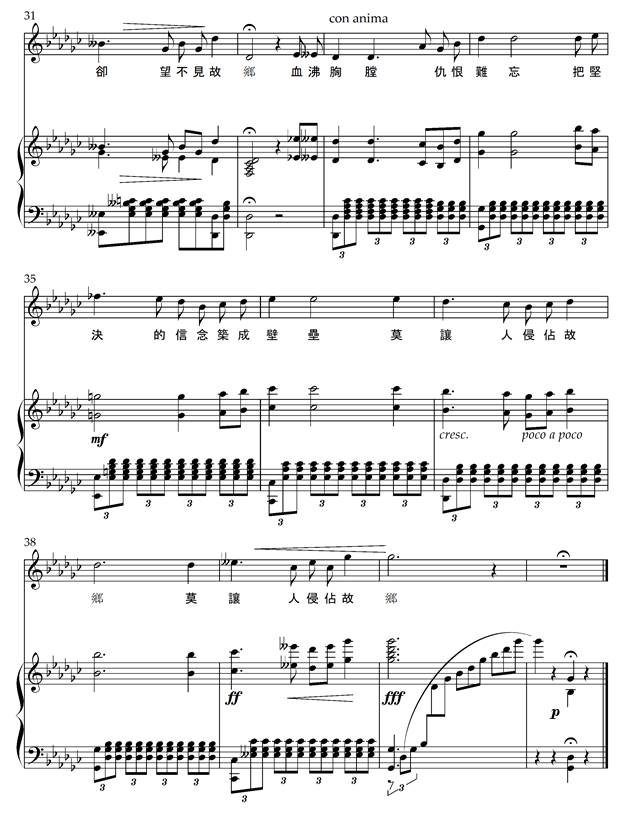
我卻望不見故鄉。
[wo3 que4 wan4 bu2 jian4 gu4 xiang1]
ㄨㄛˇ ㄑㄩㄝˋ ㄨㄤˋ ㄅㄨˊ ㄐㄧㄢˋ ㄍㄨˋ ㄒㄧㄤˉ
I, on the other hand, cannot see my hometown.
血沸胸膛,
[xie3 fei4 xiong1 tan2]
ㄒㄧㄝˇ ㄈㄟˋ ㄒㄩㄥˉ ㄊㄤˊ
Blood boiling in my chest,
仇恨難忘,
[chou2 hen4 nan2 wang4]
ㄔㄡˊ ㄏㄣˋ ㄋㄢˊ ㄨㄤˋ
With inextinguishable abomination,
把堅決的信念築成壁壘。
[ba3 jian1 jue2 di5 xin4 nian4 zhu2 cheng2 bi4 lei3]
ㄅㄚˇㄐㄧㄢˉ ㄐㄩㄝˊ ㄉㄧ˙ㄒㄧㄣˋ ㄋㄧㄢˋ ㄓㄨˊ ㄔㄥˊ ㄅㄧˋ ㄌㄟˇ
Build fortresses with our unbending faith.
莫讓人侵佔故鄉。
[muo4 rang4 ren2 qin1 zhan4 gu4 xiang1]
ㄇㄛˋ ㄖㄤˋ ㄖㄣˊ ㄑㄧㄣˉ ㄓㄢˋ ㄍㄨˋ ㄒㄧㄤˉ
Do not allow our enemies to invade our hometown.
__“Hometown Beyond the White Clouds”
Unlike many other patriotic songs of the war era, Baiyun guxiang 白雲故鄉 (1938) was written in Hong Kong, officially a colony of the Great Britain. The lyricist Wei Hanzhang 韋瀚章 and the composer Lin Shengxi 林聲翕, both natives of Guangdong Province, were active professionally in Shanghai in the 1930s. As the Sino-Japanese war broke out, they retreated to Hong Kong. When standing at the beach of Repulse Bay 淺水灣[1] overlooking the misty mountains in the distance, Wei put down the nostalgic verses and asked his younger colleague to set them to music.
__Hong Kong during the Sino-Japanese Conflicts
After overtaking the Northeast, Shanghai and Nanjing, Japanese Imperial Army continued their operations southward, seizing coastal areas and ports. Guangzhou 廣州, the capital of Guangdong 廣東省 and the south most major port of China, became a crucial entry point for commercial goods and military supplies. In 1936, the eve of the Sino-Japanese war, Yuehan Railway 奧漢鐵路, connecting Guangzhou in the south and Hankou, Hubei 漢口, 湖北 in Central China, was completed after decades of delays.[2] Via Jinghan Railway 京漢鐵路 on the other side of Yangtze River, it further reached Beijing in Northern China.[3] Hong Kong, immediately south of Guangzhou, and under British control, provided the inland Chinese defense forces with access to international information and support.
To cut off this lifeline, Japanese Headquarters began an aggressive military campaign named “Canton Operation” in October of 1938. Despite the great efforts of local forces, Guangzhou and the Pearl River Delta fell into the Japanese hands within weeks.[4] Hong Kong became isolated from the mainland and surrounded by Japanese forces. As a colony of the UK and sheltered by international influences, it remained a safe ground for many refugees from mainland for some time.
Both the United Kingdom and the Empire of Japan were signatories of post-World War I international naval treaties such as the Washington Naval Treaty, signed by the Allies of WWI in 1922, and the subsequent London Naval Treaty, signed in 1930.[5] As the global tensions escalated in the 1930s, British officials began enhancing the defense structure and bringing in reinforcement troops to Hong Kong. In early 1936, as part of the British arms expansion program, a five-hundred-million-pound budget was allocated for Hong Kong. Unfortunately, the execution of the expansion was prioritized for the home territory and delayed in the colony.
After the expiration of the London Naval Treaty, Japan began strategizing wars against the British and the Americans. Internal strategic differences between Japanese administrative and military leaders delayed the actions for several years. On December 7, 1941, Japanese navy attacked US Naval Base at Pearl Harbor and, a few hours later, Hong Kong. After weeks of intense combat, Mark Aitchison Young, the Governor of Hong Kong, surrendered on Christmas Day to avoid further bloodshed.[6] Japanese occupied Hong Kong until August of 1945.[7]
__Wei Hanzhang 韋瀚章 (1906-1993)
Wei Hanzhang, courtesy name Haoru 浩如, was from Xiangshan County 香山縣 (today’s Juhai City 珠海市) of Guangdong Province. [8] He began learning phonology and versification with Wu Xinglian吳醒濂 at an early age. While attending Nanyang Business High School in Shanghai 上海南洋甲種商業高中, he studied Chinese literature with Wang Zizhen 王子楨. In 1924, he entered Hujiang University 滬江大學,[9] mentored by Lin Chaohan 林朝翰, a scholar of the Qing-Dynasty Hanlin Academy 瀚林院,[10] laying the groundwork for his poetical achievements. Upon his graduation in 1929, he was appointed the Registrar of the National Conservatory of Music, where he befriended composer Huang Zi 黃自 and likely became familiar with Huang’s student Lin Shengxi 林聲翕.
Wei collaborated with Huang on “Kàngdí ge” (抗敵歌 Song of Resisting the Enemies), one of the earliest patriotic wartime songs, soon after 9-1-8 Incident. In 1932, they co-created “Qi zheng piāo piāo” (旗正飄飄, The Flags Are Billowing), another patriotic work, andthe art song Xiang (思鄉, Thinking of Home). These works led to Wei Hanzhang’s lifetime devotion to lyric writing. Among his highest achievements was the ten-part cantata Chang hen ge (長恨歌, Song of Perpetual Longing).[11] Inspired by the Yuefu 樂府of the same title by Bai Juyi 白居易 (722-846), Chang hen ge opens with the sublime love affair between Emperor Xuanzong of the Tang Dynasty 唐玄宗 and Yang Yuhuan 楊玉環.[12] The middle movements depict the political and military turbulences which lead to the unavoidable tragic ending. Wei’s exquisite lyrics demonstrate his command of traditional versification and his extraordinary ability to match the linguistic rhythm and dramatic movements.
In 1936, soon after leaving the National Conservatory for an employment in Nanjing, Wei became seriously ill and was transferred to Hong Kong for treatments. After convalescence, he worked for Hong Kong Commercial Press 香港商務印書館.[13] As the company began organizing a choir, he recommended Lin Shengxi to lead the group.
In Lin, Wei found a kindred spirit. In 1938, Wei handed freshly written verses Baiyun guxiang to Lin to set to music. As a creative team, they went on collaborating on art songs, film music, choral pieces, and large-scale works. They were both committed to the development of music education in Hong Kong. In the 1950s, they served on the faculty of the China School of (Christian) Sacred Music 基督教中國聖樂院—today’s Hong Kong Music Institute 香港音樂專科學校[14]. Wei taught Chinese poetry and Lin, music theory and history.
During the Second World War, Wei and his wife found sanctuary in Fanyu 番禺, outside of Guangzhou. From 1946 to 1949, he returned to Shanghai and held administrative position at Hujiang University. Based in Hong Kong in his later years, he also brought his knowledge and work to other regions of Southeastern Asia. In 1959, he joined the Borneo Literature Bureau 沙勞越文化出版局, set up by the Crown Colony of Sarawak in Kuching 古晉, handling editing and publications of Chinese book.[15] He remained in Kuching until 1970 and continued to promote cultural education among the Chinese diaspora. His contributions were celebrated widely among Chinese-spoken populations.
__Lin Shengxi 林聲翕 (1914-1991)
Lin Shengxi was born in Xinhui 新會, Guangdong. He attended Guangzhou Music Conservatory in 1931, studying piano with Huang Wancheng 黃晚成. In the following years, he entered the National Conservatory in Shanghai, majoring in piano. While there, he studied harmony with Xiao Youmei 蕭友梅 and composition with Huang Zi.
He returned to Guangzhou in 1935 after graduation. In 1936, he was employed by Columbia Records in Hong Kong[16] as a composer and arranger and appointed as the director of the Commercial Press Chorus. After the Japanese occupation of Hong Kong, Lin went to Chongqing, the wartime capital. In 1942, he assumed the directorship of the Symphony Orchestra of China 中華交響樂團, a governmental sponsored group.[17] After the war, the orchestra moved to Nanjing and continued performing until 1949 when CCP took over the city. After 1950, Lin resided permanently in Hong Kong. As a composer, music educator, publisher and leader of various music groups, he became one of the most influential musicians of the late twentieth century in Hong Kong.
Huang Zi and Wei Hanzhang began working on Chang hen ge in 1931. While most of choral sections were completed and performed in the 1930s, by the time of Huang’s death in 1938, three solo parts—movements four, seven and nine—were unfinished. His student Chen Tianhe 陳田鶴 brought the manuscript to safety after the fall of Shanghai. In 1972, Lin Shengxi set the remaining sections to music and completed the entire work.
In 1981, Wei and Lin co-created on a three-act opera Yìshui song bié (易水送別, Farewell by the Yì River).[18] Based on the historical story of Jing Ke’s 荊軻 assassination of King Zheng 秦王政, who later became the emperor of the Qin Dynasty,[19] the work was written for the Hong Kong Chinese Orchestra, a large ensemble of Chinese instruments.[20] Under the sponsorship of the Urban Council, it premiered on December 23, 1981, at the City Hall, followed by three more performances. This opera marked the final large-scale collaboration between the librettist and the composer.
__Baiyun guxiang
The lyrics of Baiyun guxiang are simple, elegant and emotional. Images of a deserted beach mirrored the desolation of the author displaced from his hometown. His grief turned into resolutions to defeat the enemies.
Poetically, Baiyun guxiang consists of four stanzas. The first two stanzas each has four lines with word counts 6-6-5-6. The third lines end on “-an,” while the others rhyme on “-ang.” Stanzas three and four make up of five lines with word counts 4-4-10-7-7. The longest lines are unrhymed vernacular verses. All other lines rhyme on “-ang,” as in the first two stanzas.
Musically, the song can be divided into two major sections parallel to the verse structure. The first section is lyrical with steady and simple accompaniments. The shorter verses in the second section, accompanied by repeating chords, energize the musical momentum.
Shortly after the completion of Baiyun guxiang, it was recorded by Columbia Records. It was circulated first in Hong Kong, and soon in mainland China. It was included in Chinese Music Classics of the 20th Century 二十世紀華人音樂經典 of 1993.
[1] Repulse_Bay_Beach_Wiki
[2] Guangzhou_Hankou_railway_Wiki, 粵漢鐵路_Wiki_zh-tw/
[3] Beijing_Hankou_railway_Wiki, 京漢鐵路_Wiki_zh-tw
[4] Canton_Operation_Wiki, 廣州戰役 (1938年)_Wiki_zh-tw
[5] Washington_Naval_Treaty_Wiki, London_Naval_Treaty_Wiki
[6] Battle_of_Hong_Kong_Wiki, 香港保衛戰_Wiki_zh-tw
[7] Japanese_occupation_of_Hong_Kong_Wiki
[8] 韋瀚章_Wiki_zh-tw
[9] Hujiang_University_Wiki
[10] Hanlin_Academy_britannica.com
[11] 長恨歌(清唱劇)_baike.baidu.com, https://www.moniquearts.com/art/criticis/long.htm
[12] Yang_Guifei_Wiki
[13] Commercial_Press_(Hong_Kong)_Wiki
[14] https://hkmi.org.hk/index.php/hkmi/about/
[15] Borneo_Literature_Bureau_Wiki
[16] Wo-Shing Company 和聲唱片, a leading record label in Hong Kong from 1930s to 1960s, produced mainly recordings of Cantonese operas and other local works. The company entered a collaboration agreement with Columbia Records to use its brand name–歌林. During the Japanese occupation, Wo-Shing moved its operation to India and continued producing patriotic music. 和聲唱片_industrialhistoryhk.org
[17] 中華交響樂團_baike.baidu.com
[18] 易水送別_baike.baidu.com
[19] Jing_Ke_Wiki
[20] Hong_Kong_Chinese_Orchestra_Wiki