__Sang Tong 桑桐 (1923-2011)
Born Zhu Jingqing 朱鏡清 in Shanghai, Sang Tong was a composer, music educator, and theorist. His ”Ye Jing”(夜景, Night scenery) for solo violin and piano (1947) was the earliest implementation of twelve-tone series by a Chinese composer. Sang credited his mentors Wolfgang Fraenkel (1897-1983), Julius Schloss (1902-1973) and Tan Xiaolin 譚小麟 for his work.
In 1941, he entered the National Music Conservatory, studying composition under Fraenkel, a Jewish musician escaping Nazi oppression in Shanghai.[1] Sang recalled being introduced to works of Debussy, Stravinsky, Vaughan Williams, Kodály, Bartok, Scriabin and Mahler.[2] In addition to analyses of standard repertoire by composers such as Bach, Beethoven, Schubert, Brahms and Richard Strauss, Fraenkel’s teaching materials included Arnold Schoenberg’s Harmonielehre (Theory of harmony) and Ernst Kurth’s Grundlagen des linearen Kontrapunkts: Bach’s Melodische Polyphonie (Foundation of linear counterpoint: Bach’s melodic polyphony).
For health reasons, Sang dropped out of the Conservatory in 1943 but re-enrolled three years later, continuing his study with Julius Schloss, a colleague and friend of Alban Berg. He also audited classes taught by Tan Xiaolin, a young professor who had studied with Paul Hindemith at Yale.[3] In 1947, Sang composed “Ye Jing” and a piano piece “Zai na yaoyuan de difang” (在那遙遠的地方, In the land far, far away) based on a folk tune from the Qinghai 青海 Province. Both explored modern compositional techniques and were premiered in 1948 in Shanghai.[4] He also collaborated with Qu Xixian 瞿希賢 on the film music for Ye Dian (夜店, Night Inn) and Yian Yiang Tian (艷陽天, Bright Sunny Days) during this period.
Frequent participant in demonstrations held by students with progressive ideology, Sang began his training by CCP in 1948. As the conflicts between CCP and KMT intensified, he relocated to Northern Jiangsu Liberated Area 蘇北解放區 and changed his name to Sang Tong. In March 1949, he became a CCP member officially and was sent back to Shanghai. In June 1949, Sang Tong assisted Shanghai Municipal Military Control Commission of the Chinese People’s Liberation Army 中國人民解放軍上海市軍事管制委員會[5] in taking control of the Music Conservatory. A few months later, he began his long teaching career there. In addition to teaching theory and composition, he held various administrative positions. From 1986 to 1991, he served as the President of the Conservatory.
Sang Tong’s writings include “Heshengxue zhuanti liu jiang” (和聲學專題六講, Six lectures on harmony), “Hesheng de lilun yu yingyong”(和聲的理論與應用 , The theory and application of harmony), “Wusheng zonghexing hesheng jiegou de tansuo”(五聲綜合性和聲結構的探索, Investigations of the structure of integrated pentatonic harmonies)[6], and “Duodiaoxing xiezuo shoufa jianjie” (多調性寫作手法簡介, An introduction to polytonal writing techniques). He passed away on July 24, 2011, in Shanghai at the age of 88.
—Integrated Harmonization of Pentatonic Melodies
In Wusheng zonghexing hesheng jiegou de tansuo (五聲綜合性和聲結構的探索, Investigations of the structure of integrated pentatonic harmonic), Sang Tong indicated that pentatonic melodies could be harmonized using basic western tonal harmonic structure—triads in major and minor tonalities—三度結構性和聲方法. Other possibilities include using parallel motions (planing) 平行進行, polychordal 複合和聲, and polytonal 複合調式structures. He believed that, in practice, harmonizations of pentatonic melody were often restricted by three notions:
- Emphasizing that the tonality of the harmony must match that of the melody
- Using only tertian chords—stacking thirds—as the structural foundation
- Relying on functional harmony
To break away from these restrictions, he explored the implementation of integrated harmonization of pentatonic melodies, based on the methodology developed by Paul Hindemith.
The key component of Hindemith’s theory is “interval,” as he wrote in his seminal treatise Craft of Musical Composition:[7]
. . . The motion from one tone to another, the bridging of a gap in space, produces melodic tension, while the simultaneous juxtaposition of two tones produces harmony. Thus the Interval, formed by the connection of two tones, is the basic unit of musical construction.
He ranks the intervals by their acoustic stability to a fundamental tone. The strength of intervals, in turn, governs the harmonic progressions, freed from the traditional functional harmonic structure.
Like Hindemith, Sang Tong builds his theory around the interplay of melodic and harmonic intervals. He explains that all the notes of a pentatonic scale could be combined into three-note, four-note, and five-note chords. Each group is subcategorized by their intervallic organization.[8] He systemizes these chords using Hindemith’s conception of intervallic strength and root identification. He emphasizes that, in integrated pentatonic harmonization, chords can be linked without hierarchical restrictions. Nevertheless, the movements of roots need to be organized around a tonal center. Harmonic intensity and colors need to be distributed orderly.
Finally, Sang prescribes methods of tonal expansion:[9]
- Expansion from five tones to six or seven tones can be created by layering multiple voices with different tonalities.
- Adding modified tones, such as qing-jue 清角 (raised-jue), bian-zhi 變徵 (lowered-zhi), qing-yu 清羽 (raised yu), and bian-gong 變宮 (lowered gong), without changing the mode and the pentatonic nature.[10]
- Modes based on the same tonal center can be combined to expand the tonality.

Sang uses these additional tones to enrich the tonalities and to balance the harmonic fluctuations.
__Sang Tong’s piano accompaniment for Hongdou ci*
*The following transcription and analysis use C as the tonal center—C minor key signature and C as yu 羽.
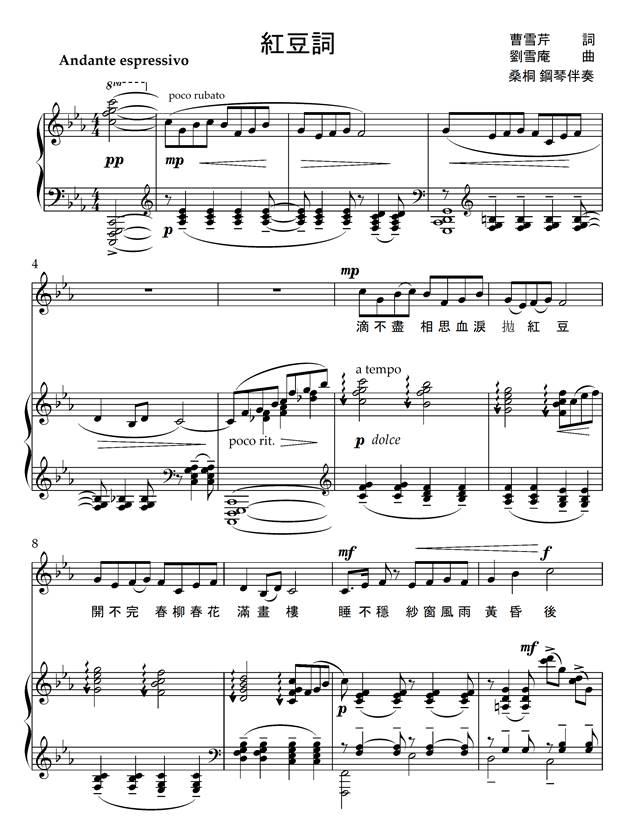
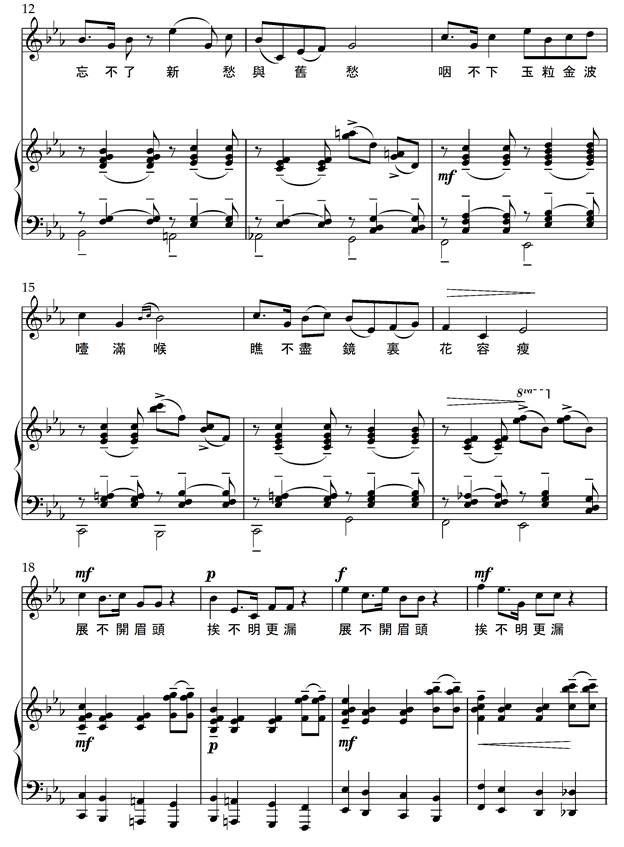
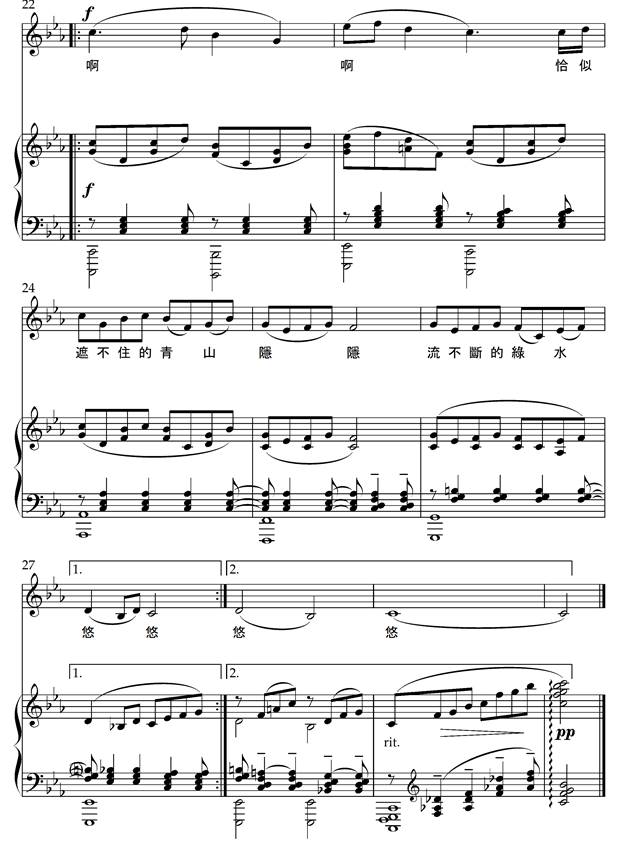
Although Sang was setting accompaniment to a song written by another composer, he was not hindered by the existing melodies. Instead, he used the pentatonic tones as constituents of harmonies—harmonic cells in Hindemith’s term. According to Hindemith, harmonic movements were felt by the increase and decrease of harmonic tensions—fluctuations. As he categorized chords into six groups by the existence or absence of tritone, the presence of second and seventh, and the root positions, he ranked them by their intervallic strength. The harmonic tension would increase with movements from lower-number groups, the more stable harmonies, to higher ones, the less stable ones. Combinations of pentatonic tones often contain seconds and sevenths but without tritones. Therefore, most of these chords would be placed under group III in Hindemith’s chord analysis. If the majority of the chords were in the same group, there would be very little fluctuation.[11] Sang solved this dilemma by implementing tonal expansions.
Sang opened his piano introduction with a four-note chord, c-f-g-c, resonating from the extreme ends of the keyboard. Without the interval of third, he established a non-western sonority immediately. Structurally, this chord contained the fifth and the fourth, two of the strongest intervals according to Hindemith. Acoustically, he utilized the rich overtones from the lower range of the instrument to achieve a colorful but open sound. This chord structure would be moved up a fifth in m. 3 and return to the first position in m. 5.
Liu Xue’an’s piano introduction, based on the thematic melody, was only two measures long and fully cadenced. Sang Tong quoted the first two vocal lines and linked them to the vocal entrance with an added measure of chords and arpeggios. The familiar syncopated repeating chords in the left hand broke the solemness created by the opening chord. They also brought in two tones outside of the pentatonic C-yu mode: The a-flat in mm. 1-2 and b-natural in m. 3. Although they could be interpreted as modified tones within the pentatonic system, a more comprehensive explanation would be that Sang overlapped the C-pentatonic melody with C harmonic minor scale.
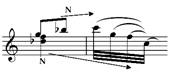
More outside tones appeared in mm. 4-5 in the right-hand parts. The two Ds in m. 4 were auxiliary bian-gong 變宮 included in the original melody. They led to the d-flats in measure 5, a completely foreign tone. Tracing the voice-leading in these two measures, a melodic movement of D-C-D-flat-C became clear. In the final beat of m. 4, a double-neighboring tone group—d-flat & b-flat—moved to the octave Cs in m. 5.
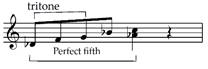
As the melody ended in m. 4, the underlaying harmony, a composite chord of minor third-perfect fifth-minor sixth, sounded an inconclusive tone. The tritone formed by the d-flat and g-jue 角 furthered the uneasiness. Structurally, this tritone was stabilized by two sets of perfect fifths: the D-flat-A-flat in the upper piano part and the rooted C-G in the bass.
The first two phrases of the vocal line (mm. 6-9), covering verses one and two of the poem, were the most straightforward section of the entire song structurally. Worth noticing, however, were the unique use of downward arpeggios in the upper register of the piano. They produced an effect reminiscent of the sliding tones on the guzheng 古箏 or the guqin 古琴. Set an octave above the vocal line, they became a phenomenon of their own.
The other distinctive feature in this opening section is the descending bass line from m.6 to m. 9. Doubling the melodic line in the first measure as in Liu’s version, it continued to descend on a C-natural minor scale (or its Chinese counterpart qing-jue mode 清角調). Here, Sang again overlayered pentatonic and heptatonic scale. Freed from functional harmonic progression, Sang was able to take this feature further. Starting with f/F in m. 10, a descending E-flat major scale was formed, with a chromatic embellishment –B-flat-A-natural-A-flat in mm. 12-13. Without the presence of tertian or traditional seventh chords, there was no clear sense of “modulation.”
Sang matched the increasing anxiousness in verses three to six and the agitated dotted-three-note motif in mm. 10, 12, 14, and 16 with syncopated chords of denser texture and accented jumping chords in the right hand. A-natural, a foreign tone, appeared frequently throughout this section. Instead of fitting it into any tonal pattern, it might be best to observe its descriptive function here. It first took place in the piano right-hand part in m. 11, coinciding with the words huang hun 黃昏 (dusk), a time when the fading of daylight obscured the scenery. Then, with the chromatic movements in the bass, it marked the words xin chou 新愁 (new sorrow) and jiu chou 舊愁 (old sorrow). It generated two palpable tritones with octave-E-flats in mm. 15 and 16, manifesting the suffering of choking and sad reflection of a waning face. These back-to-back tritones caused a ripple in the harmonic movement.
Sequential bass lines in mm. 18 to 21 brought in a sense of relentlessness. The two A-naturals should simply be treated as passing tones. The onomatopoeic chords in the final beat of each measure should be handled carefully.
With the upper piano parts doubling the melodic lines, the final section of Sang Tong’s arrangement of Hongdou ci was marked by frequent occurrences of tritones. The A-natural-D combination in m. 23 stirred up a quick III-V-III harmonic movement stressing the pains in the vocal cries. A longer and less stable harmony with an F-B tritone in m. 26 was eased in the first ending but went unresolved onto another tritone chord in the second ending. While most composers sought smooth and conclusive endings, Sang chose to, in the penultimate measure, circle back to the open-ended harmony linking the introduction and the initial vocal line. He then evoked the opening c-f-g-c chord yet added a seventh, the least stable interval. The message of the never-ending longing could not be clearer.
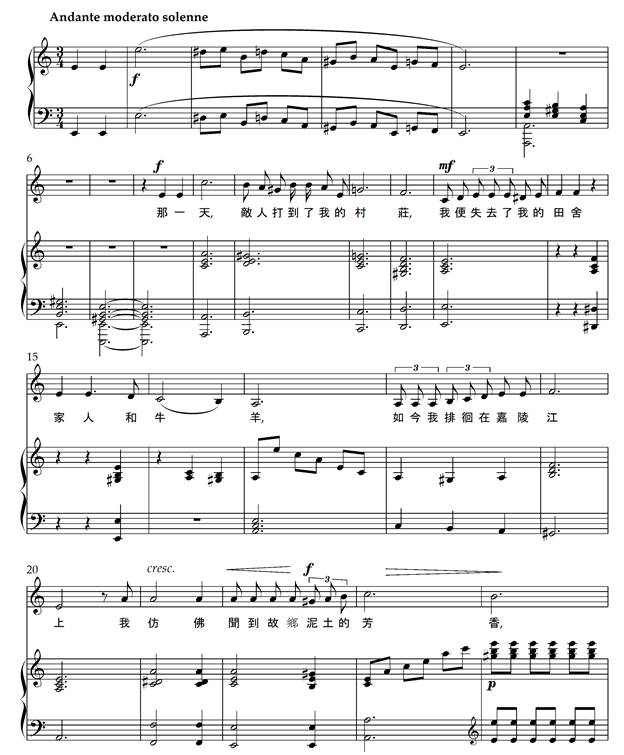
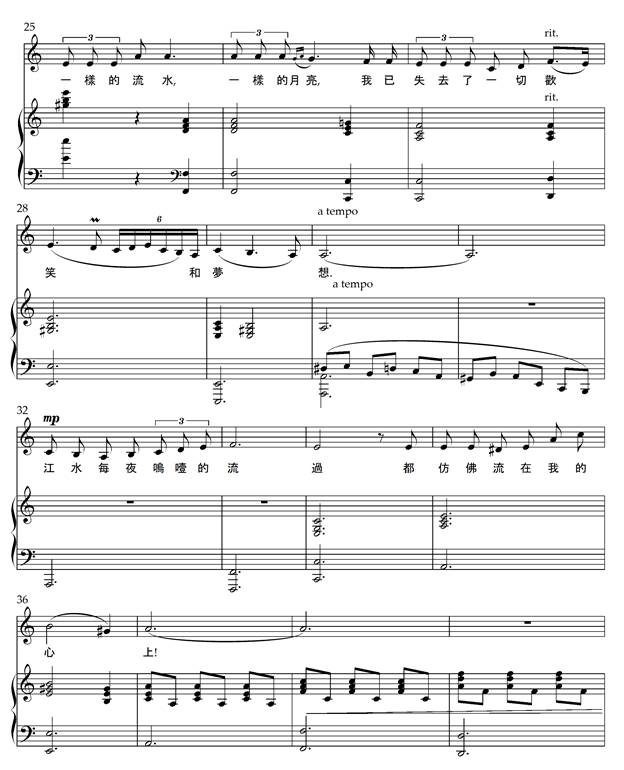
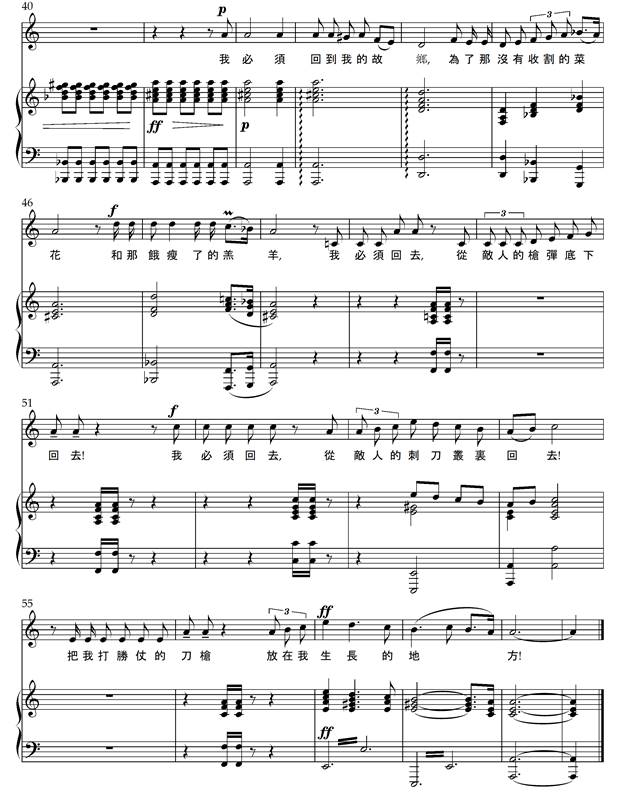
In his piano accompaniment for Hongdou ci, by combining traditional and western musical practices, Sang Tong cracked open a field of possibilities for Chinese composers. By exploring the acoustic boundaries and performing techniques, he also elevated the role of the piano in an art song. Given the fact that Liu Xue’an’s works were banned in China until early 1980s, it could only have become popular in the final decades of the twentieth century. It represented the result of deeper western influences during the late 1940s, directly and indirectly, to a generation of composers.
[1] Christian Utz, “Cultural Accommodation and Exchange in the Refugee Experience: A German-Jewish Musician in Shanghai,” Ethnomusicology Forum, vol.13, no. 1, January 2004, 119-151.
[2] Sang Tong 桑桐, “Jinian Fulanke’er yu Xu Luoshi” (紀念弗蘭克爾與許洛士, In memory of Wolfgang Fraenkel and Julius Schloss), Yinyue Yishu (音樂藝術, The Art of Music: Journal of the Shanghai Conservatory of Music), 12, no. 1 (1990): 10-15
[3] https://en.wikipedia.org/wiki/Tan_Xiaolin
[4] Utz, Musical Composition in the Context of Globalization: New Perspectives on Music History of the 20th and 21st Century, trans. Laurence Sinclair Willis (Bielefeld: Transcript-Verlag, 2021), 182. https://doi.org/10.14361/9783839450956.
[5] Qian Yiping 錢亦平, “Sang Tong Xiansheng’” 桑桐先生, 17, quoted in Cheong Wai-Ling, “Reading Schoenberg, Hindemith, and Kurth in Sang Tong: Modernist Harmonic Approaches in China,” Acta Musicologica 88, no. 1 (2016), 7.
中國人民解放軍上海市軍事管制委員會_zh.Wiki/zh-tw/
[6] Sang Tong, “Wusheng zonghexing hesheng jiegou de tansuo, Yinyue Yishu, 2, no. 1 (1980): 20-44. This title is somtimes translated as “The Vertical Structure of Pentatonic Harmonies.” Since Sang’s discussion included both the horizontal and vertical applications of pentatonic scales, the terms “integrated” or “composite” (綜合性) are much more comprehensive than “vertical” (綜向性).
[7] Paul Hindemith, The Craft of Musical Composition, Book 1, Theoretical Part,trans. Arthur Mendel, (Associated Music Publisher, 1942): 57
[8] Sang, Ibid., 23-24.
[9] Ibid., 34-40.
[10] Xiao Yomei 蕭友梅 in “Gujin zhongxi yingjie gaishuo 古今中西音階概說” (Survey of ancient and modern Chinese and western scales) traced the historical development of Chinese heptatonic scales. He also listed the eight-four possible heptatonic scales (seven modes on twelve tones), using the Western church mode comparison. Yueyi, 1930: 14-25
See also 七聲調式_zh.Wiki/zh-tw/
[11] In Hindemith’s chord group, III 1 and III 2 differ only in their root positions. III 2 chords can be considered as inverted III 1. Thus, the movements back and forth between the two are subtle.