
Yesterday was 端午節 (Duanwujié, commonly known as Dragon Boat Festival) for 2019. 端午 Duanwu takes place on the fifth day of the fifth month (午月) in Chinese lunar calendar. There are many different theories on the origin of this holiday. I will stay with the version that is familiar to most Chinese children.
屈原 (Qu Yuan, c. 340-278 BC) was a nobleman of the State of Chu (楚國) during China’s Warring States period. He was a poet and an influential member of the court of King Huai (懷王).[1] Unfortunately, he became the victim of power struggles both within the court and between Chu and neighboring states, and was banished to remote regions multiple times. As the powerful Qin State gaining the control of Chu’s capital city, Qu Yuan committed suicide, drowning himself in Miluo (汨羅) River, holding a heavy rock. When locals learned of the tragedy, they beat drums and rolled out boats to drive away fish and evil spirits; they dropped rice into the river so fish would not harm the Qu Yuan’s body. Thus began the traditions of dragon boat races and eating rice dumplings (zongzi, 粽子).[2]
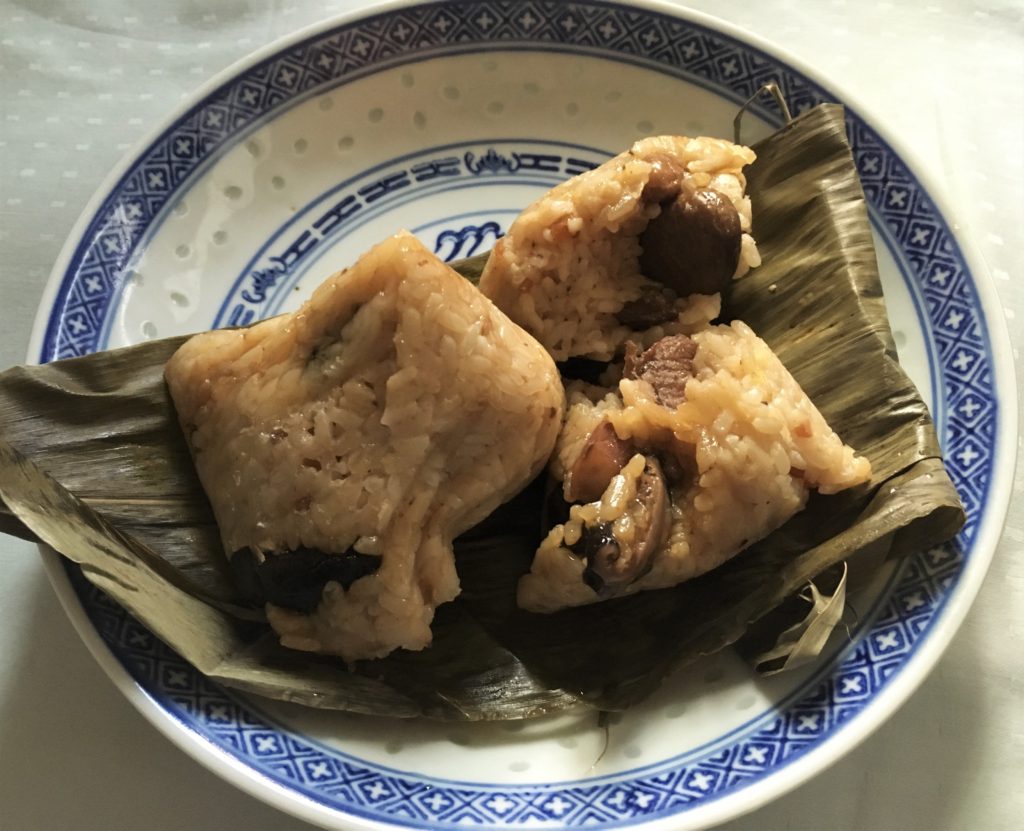
The main ingredient for 粽子is sweet sticky rice. There are many regional varieties. They can be savory or sweet. Usually, they are wrapped in dried bamboo leaves and tied up with twine. Mom learned to make central-Taiwanese style zongzi from our neighbor Mrs. Lee. The ingredients included braised pork belly, shiitake mushrooms, peanuts and chestnuts. (Sounds labor-intensive already, doesn’t it?) Occasionally, mom would add salted duck egg yolks. Although it’s fun to watch mom wrapping the ingredients with rehydrated bamboo leaves, I loved even more helping her prepare the sticky rice. Finely chopped shallots, dried shrimp and pickled Daikon radish were fried in hot oil. Pre-soaked and drained rice would then be added to the wok. To prevent the rice from sticking to the wok, one must stir the rice mixture constantly while gradually adding broth/sauce. (Chinese risotto, anyone?)
We used to wait for eating zongzi once a year. Nowadays, freshly made zongzi are available all-year-round at night markets, from street vendors, and even in the frozen food section of grocery stores. Fewer people take on the time-consuming task of making them at home. I missed walking down the streets when very family was busy preparing zongzi. The smell of sticky rice and bamboo leaves would come through every kitchen window, sweet and warm.
It was a common practice in Taiwan to eat eggplant and long string beans on Duanwu. Mom always cited the idiom: “吃茄會超騰,吃豆吃到老”[3] (“Eating eggplants makes one energetic and lively; eating beans will bring longevity.”) In Taiwanese, 茄 (eggplant) is pronounced “kio, ㄍㄧㄡˊ;” rhyming with 超騰 “chio—tio, ㄑㄧㄡ/ㄊㄧㄡˊ.;” 豆 (bean, dou; ㄉㄠˇ), rhyming with 老 (old, lau; ㄌㄠˊ). I always loved vegetables. Unfortunately, mom’s blanched eggplants and beans on Duanwu were always plain. The addition of sesame oil and soy sauce didn’t help much. Perhaps mom thought that, with the flavorful zongzi, she could go light on the veggies.
In southern China, salted duck eggs with red yolks are part of the celebratory food tradition. Some people believe that, because of the positions of sun and earth on Duanwu, it is possible to balance fresh chicken eggs upright on flat surface (立蛋). It brings one good fortune throughout the year.
In Chinese culture, Duanwu marks the arrival of summer, when venoms become active. People hang bundles of 艾草 (artemisia), 蒼蒲 (acorus calamus), and 香茅 (lemongrass) on the door to keep evil spirits away.[4] They drink realgar wine (雄黃酒) for disease-prevention.[5] Sometimes, the liquor is rubbed on the forehead of children too young to consume alcoholic drinks. (It is very similar to the practice of worshipers receiving ashes on their forehead on Ash Wednesday.)
Kids are also given perfume pouches (香包) made of colorful fabric in all shapes and forms[6] filled with perfuming spices for protection. At school, we made zongzi-shaped perfume packages with craft paper or cardstock and wrapped them with multi-colored silky threads. Later, I learned to make pouches with leftover fabrics and kept them in my drawers and closets. The practices of using herbs and spices for protection might have started with superstitions. But it makes perfect sense to strengthen one’s immune system as the hot summer months arrives, and to use natural insect repellents.
Like all children, I loved Duanwu for the smell of zongzi, for the beautiful perfume pouches and for the excitement of dragon boat races. Like all children, I also knew that the school year would soon be over. Happy summer months were in sight.
[1] Qu Yuan’s literary works are collected in the anthology 楚辭 (Chu Ci), representative of early poetic writing of southern China. Chu_Ci_: Wiki
Among them was the epic poem 離騷 (Li Sao), in which Qu Yuan expressed his political ideal and despair. Li_Sao: Wiki
Contrasting to the anonymous works in 詩經 (Shijin, Classic of Poetry), representative of the northern style, Qu’s approach was personal and romantic. The two anthologies became the foundation of Chinese poetic writing. Classic_of_Poetry_Chinese: Wiki
[2] Life-in-Taiwan-dragon-boat-festival
[3]A variant of the phrase is “食茄吃到會搖,吃豆吃到老老”
[4]Garlic and additional herbs are added according to regional preferences and practices.
[5]Realgar_wine: WikiSince realgar contains arsenic sulfide, despite it being an effective insect repellent, it is probably not a great idea to consume realgar wine.
[6]Images of perfume pouches
