Musical Settings (VIII): “How Can I Help but Think of Her,” The Song

This entry is part 30 of 38 in the series Chinese Art Song

__Xinshi geji 新詩歌集

Four years after the publication of Xinyue chuji 《新樂初集》, Zhao Yuanren 趙元任 (1892-1982) brought forward his song collection Xinshi geji 新詩歌集 [Songs of contemporary poems].[1] Except for the first half of the song “Ping hua 瓶花” [Flowers in the Jar][2], all the lyrics in the collection were written in plain language by contemporary authors, including “Autumn Bell 秋鐘,” a poem by the composer himself. The words of “Drinking song” (No. 12) was translated from The Lady of the Camellias by Liu Bannong.[3]

Right from the beginning of the introduction, Zhao clearly indicated that the works in the selection modeled after the art song style of Schubert and Schumann.[4] Twelve of the fourteen songs are for solo voice and piano. “Workmen’s Song 勞動歌” (No. 8) could be sung by one singer but would be more effective and exciting as an ensemble piece. “Sea Rhyme 海韻” (No. 14), written for a mixed voice choir with a soprano solo, could be treated as a solo song without the chorus.

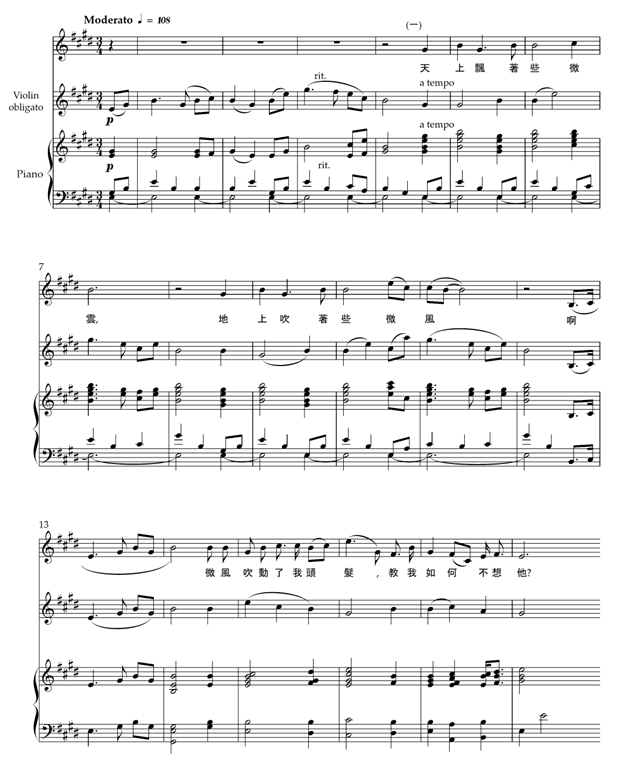
Several songs in the collection have become part of the standard Chinese art song repertoire. Among them, “Jiao wo ruhe buxiang ta 教我如何不想她” [How Can I Help but Think of Her?][5] set to the words of Liu Bannong was the most popular work, beloved by musicians and audience alike.

__Zhao Yuanren and Liu Bannong 趙元任和劉半農

Liu Bannong 劉半農 (1891-1934), a.k.a. Liu Fu 劉復[6], was a pioneer of literary reform and a frequent contributor to the New Youth magazine.[7] Before making Liu’s acquaintance, Zhao Yuanren recognized the linguistic fluidity in his new style poetry. After the publication of Liu’s Sisheng shiyan lu《四聲實驗錄》 [Records of Experiments on the Four Tones] in 1924,[8] Zhao realized Liu was also a serious linguist.

In 1924, during his research tour in Europe, Zhao visited Liu, who was completing his Ph.D. studies in Paris. Both passionate in linguistic/phonetic studies and music,[9] they struck up a friendship immediately. Zhao accepted a teaching position at Tsinghua University in 1925. Liu also returned to China in August of the same year and began teaching at Beijing University and l’Université Franco-Chinoise 中法大學.

They formed an informal society “Suren hui 數人會”—literally, “a few people’s group”—with Qian Xuantong 錢玄同, Li Jinxi 黎錦熙, Lin Yutang 林語堂 and Wang Yi 汪怡, all reform-minded linguists/phonologists.[10] Between September 1925 and September 1926, they held twenty-two meetings at Zhao’s house, developing a Romanized spelling system of Chinese language. The result of their study was known as “Gwoyeu Romatzyh 國語羅馬字,” briefly adopted by the Nationalist government but eventually replaced by Pinyin.[11]

While highly intelligent, Zhao and Liu both possessed a sense of humor—self-deprecating at times. More than a professional bond, their kinship was a personal one and lasted until Liu’s untimely death in 1934. The songs that they co-wrote were testimonies of their creative minds.

__ “Jiao wo ruhe buxiang ta 教我如何不想她”

The poem was written on September 4, 1920, in London. Originally entitled “Qing ge 情歌” [Love song], the new title 教我如何不想她 first appeared in Liu’s poetic collection Yang-bian ji 揚鞭集 (1926).[12] Prior to this poem, the third person singular pronoun “他 ta” in Chinese language was gender neutral. Liu used the character “她” with a radicle “女 nü,” indicating the feminine gender of the subject. It was widely believed that the poet used it as a metaphor of the “mother land,” and the poem was a love song to the country. In an interview conducted by Rosmary Levenson in 1970s, Zhoa indicated that the subject should be gender neutral and without specific associations.[13] Interestingly, in Xinshi geji, he used “他” as the title for his setting of a short poem by Hu Shi 胡適. Yet he translated it as “She” for the English song list and noted: (i.e. China).

Since the text, translation, and structure of the poem has been discussed in an earlier post, only the pronunciation guide will be provided here: [14]

天上飄著些微雲,
[tian1 shang4 piao1 zhe5 xie1 wei2 yun2]
ㄊㄧㄢˉ ㄕㄤˋ ㄆㄧㄠˉ ㄓㄜ˙ ㄒㄧㄝˉ ㄨㄟˊ ㄩㄣˊ

地上吹著些微風。
[di4 shang4 chui1 zhe5 xie1 wei2 feng1]
ㄉㄧˋ ㄕㄤˋ ㄔㄨㄟˉ ㄓㄜ˙ ㄒㄧㄝˉ ㄨㄟˊ ㄈㄥˉ

啊! 微風吹動了我頭髮,[15]
[a1 wei2 feng1 chui1 dong4 liao3 wo3 to2 fa3]
ㄚˉ ㄨㄟˊ ㄈㄥˉ ㄔㄨㄟˉ ㄉㄨㄥˋ ㄌㄧㄠˇ ㄨㄛˇ ㄊㄡˊ ㄈㄚˇ

教我如何不想她?
[jiao4 wo3 ru2 he2 bu4 xiang3 ta1]
ㄐㄧㄠˋ ㄨㄛˇ ㄖㄨˊ ㄏㄜˊ ㄅㄨˋ ㄒㄧㄤˇ ㄊㄚˉ

******************************

月光戀愛著海洋,
[yue4 guang1 lian4 ai4 zhe5 hai3 yang2]
ㄩㄝˋ ㄍㄨㄤˉ ㄌㄧㄢˋ ㄞˋ ㄓㄜ˙ ㄏㄞˇ ㄧㄤˊ

海洋戀愛著月光。
[hai3 yang2 lian4 ai4 zhe5 yue4 guang1]
ㄏㄞˇ ㄧㄤˊ ㄌㄧㄢˋ ㄞˋ ㄓㄜ˙ ㄩㄝˋ ㄍㄨㄤˉ

啊!這般蜜也似的銀夜。
[a1 zhe4 ban1 mi4 ye3 si4 di1 yin2 ye4]
ㄚˉ ㄓㄜˋ ㄅㄢˉ ㄇㄧˋ ㄧㄝˇ ㄙˋ ㄉㄧ˙ ㄧㄣˊ ㄧㄝˋ

教我如何不想她?
[jiao4 wo3 ru2 he2 bu4 xiang3 ta1]
ㄐㄧㄠˋ ㄨㄛˇ ㄖㄨˊ ㄏㄜˊ ㄅㄨˋ ㄒㄧㄤˇ ㄊㄚˉ

******************************

水面落花慢慢流,
[shui3 mian4 luo4 hua1 man4 man4 liu2]
ㄕㄨㄟˇ ㄇㄧㄢˋㄌㄨㄛˋ ㄏㄨㄚˉ ㄇㄢˋ ㄇㄢˋ ㄌㄧㄡˊ

水底鱼兒慢慢游。
[shui3 di32 er5 man4 man5 you2]
ㄕㄨㄟˇ ㄉㄧˇ ㄩˊ ㄦ˙ ㄇㄢˋ ㄇㄢ˙ ㄧㄡˊ

啊! 燕子你說些什麽話?
[a1 yan4 zi5 ni3 shuo1 xie1 she2 me5 hua4]
ㄚˉ ㄧㄢˋ ㄗ˙ ㄋㄧˇ ㄕㄨㄛˉ ㄒㄧㄝˉ ㄕㄜˊ ㄇㄜ˙ ㄏㄨㄚˋ

教我如何不想她?
[jiao4 wo3 ru2 he2 bu4 xiang3 ta1]
ㄐㄧㄠˋ ㄨㄛˇ ㄖㄨˊ ㄏㄜˊ ㄅㄨˋ ㄒㄧㄤˇ ㄊㄚˉ

******************************

枯樹在冷風裏搖,
[ku1 shu4 zai4 leng3 feng1 li yao2]
ㄎㄨˉ ㄕㄨˋ ㄗㄞˋ ㄌㄥˇ ㄈㄥˉ ㄌㄧˇ ㄧㄠˊ

野火在暮色中燒。
[ye3 huo3 zai4 mu4 se4 zhong1 shao1]
ㄧㄝˇ ㄏㄨㄛˇ ㄗㄞˋ ㄇㄨˋ ㄙㄜˋ ㄓㄨㄥˉ ㄕㄠˉ

啊! 西天還有些兒殘霞,
[a1 xi1 tian1 hai2 you3 xie1 er5 can2 xia2]
ㄚˉ ㄒㄧˉ ㄊㄧㄢˉ ㄏㄞˊ ㄧㄡˇ ㄒㄧㄝˉ ㄦ˙ ㄘㄢˊ ㄒㄧㄚˊ

教我如何不想她?
[jiao4 wo3 ru2 he2 bu4 xiang3 ta1]
ㄐㄧㄠˋ ㄨㄛˇ ㄖㄨˊ ㄏㄜˊ ㄅㄨˋ ㄒㄧㄤˇ ㄊㄚˉ

The above transliteration is largely based on Zhao Yuanren’s own interpretation in a Pathé-Columbia Recording.[16] Details of a few words/characters should not be overlooked:

  • The literary pronunciations are used for the adverb 了 [liao3/ㄌㄧㄠˇ] in stanza 1, verse 3 and the particle 的 [di1/ㄉㄧˉ], stanza 2, verse 3.
  • The reiterative locution 慢慢 (slowly, slowly) in stanza 3 is treated differently in verses 1 and 2. In the first verse, it is sung with consecutive fourth tone [man4 man4/ㄇㄢˋ ㄇㄢˋ] accompanied by legato melodic line. In the second verse, the words are set to a dotted-note pattern with a short ending. Thus, the neutral (light) tone should be applied to the second character.
  • The兒 in the two erhua word-groups, namely 鱼兒 in stanza 3, verse 2, and 有些兒 in stanza 4, verse 3, should both be pronounced with clear [ㄦ/er] sound but lighter than the regular second tone.
  • In the appended section of Xinshi geji, Zhao discussed various pronunciations of the character還 which appeared in stanza 4, verse 3. Finding the literary pronunciation [ㄏㄨㄢˊ/huan2] too artificial, he suggested a modified sound [ㄏㄢˊ/han2] for lyrics in the collection. The latter is hardly heard today. To fit the vernacular characteristics of the poem, the colloquial pronunciation [ㄏㄞˊ/hai2] is applied here. [17]

__The Song

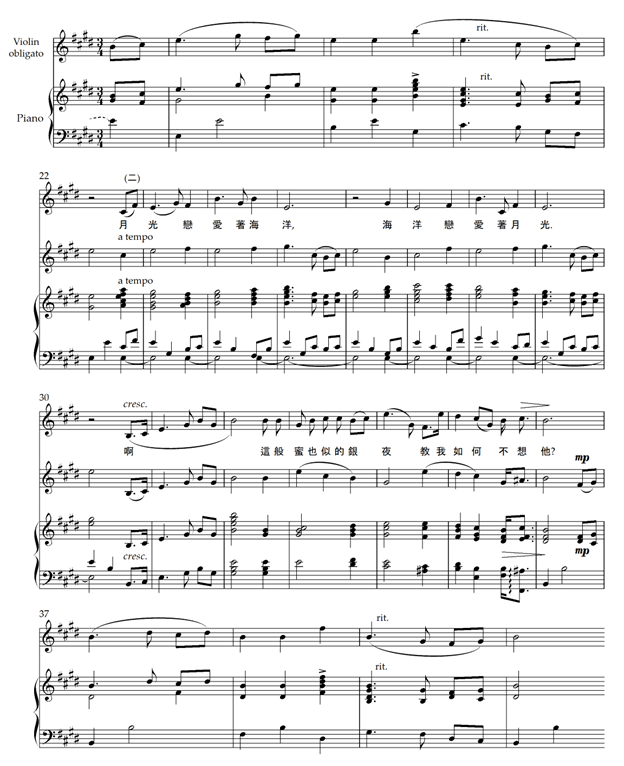
Structurally, Zhao’s musical setting corresponds to the poetic construct—sectional with repeated texts set to slightly varied refrains. In the opening phrases, a pedal tone on E3 in the piano part (mm. 1-12) firmly established the tonal center for the entire piece. While using the standard harmonic progressions in the accompaniment, Zhao achieved a Chinese-sounding melodic line by avoiding the pitches a and d-sharp, the fourth and the seventh note of the E major scale.

At the entrance of the second stanza (m. 22), the E3 pedal tone returns. The melodic line remains in the pentatonic mode as the tonality gradually shifts into the dominant B major. A four-bar instrumental extension (mm. 37-40) concludes the first half of the song.

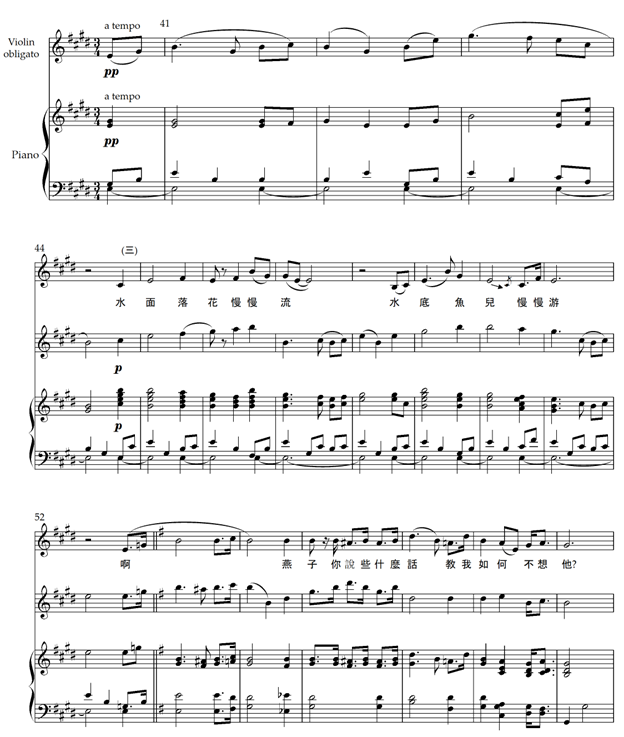
The opening introduction returns in m. 41. Although the E3 pedal tone and the E major chord progression reoccur (mm. ’40-52), the vocal lines from mm. ’44-51 is centered around c-sharp, the tonic of the relative minor key. The key signature changes to one sharp in m. 53, indicating a shift to the parallel E minor. The repeated a-sharps in the new phrases (mm. 53-55) pushes the tonality toward the dominant B minor before settling into G major, the relative key of E minor. (mm. 57-58).

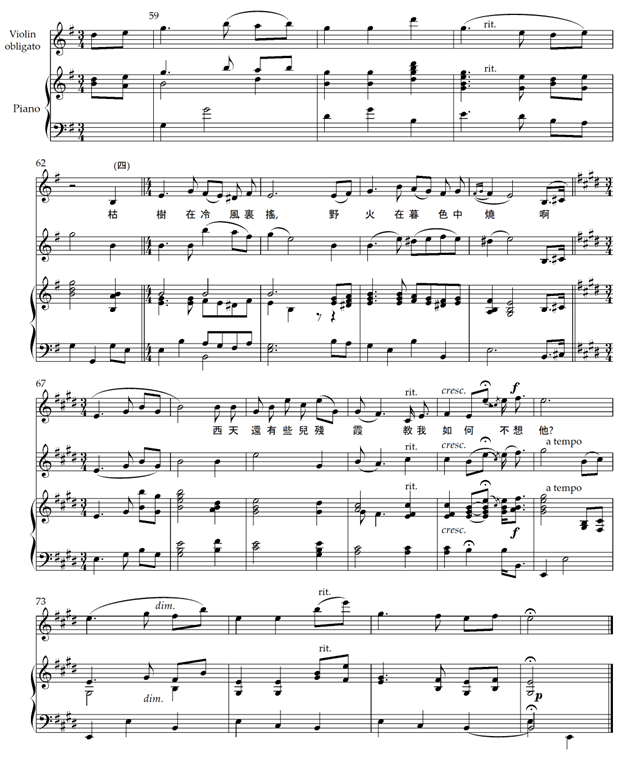
After a brief interlude (mm. ’58-62) is in G pentatonic major, the fourth—and last—stanza begins in E minor. The darker harmonic tone was enhanced by a meter change from triple to quadruple, slowing down the musical movements (mm. 62-66). As indicated in the text, the gloomy mood was not to stay: “. . . Some twilight glows are still lingering on the western sky.” The triple meter is restored. The song ends with a strong ending in E major.

__ Xipi yuanban guomen 西皮原板過門

The composer wrote in the commentary section of the songbook that, with the exceptions of “燕子你說些什麽話?” (mm. ’54-56) and “枯樹在冷風裏搖, 野火在暮色中燒。” (mm. ’62-66), the song was characteristically Chinese.[18] In addition to balancing pentatonic melodies and western-styled harmonies, he adopted the cadential passage of xipi yuanban guomen 西皮原板過門, the instrumental interlude in Chinese opera, for the refrain –and the theme—of the song, “教我如何不想她?”

The use of preexisting melody, cantus firmus, is a common practice in western musical tradition. With Chinese (Peking) opera being a popular form of entertainment, Zhao’s choice of his basic melodic pattern was a familiar one to the readers and interpreters when the work was written. It would, nonetheless, require some explanations to today’s performers and audiences, Asian and western alike.

With a wide range of subject matters and dramatic styles, musically, the entire repertoire of Peking opera was built upon two melodic patterns, xipi 西皮 and erhuang 二黃, and their variations. The fundamental differences between them are the tuning on the jinghu 京胡,[19] a two-string bowed instrument which plays the melody heterophonically with the singer. The two strings on the jinghu are always tuned a fifth apart. For xipi, the open strings are tuned to d and a, the sixth (lower) and the third of an F scale. For erhuang, they are tuned one step lower to c and g. This results in xipi sounding brighter and vivacious, and erhuang¸ mellower and more lyrical.

Both melodic types have several different tempos and rhythmic patterns. The primary ones are called yuanban 原板, meaning “the original beat pattern.” Xipi yuanban is a two-beat pattern, alternating between ban 板, the strong beat played on a clapper called paiban 拍板,[20] and yan 眼, the weak beat played on a small drum.

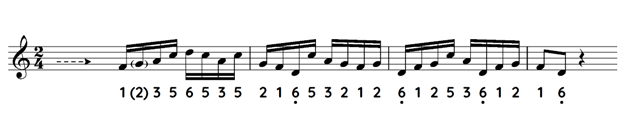
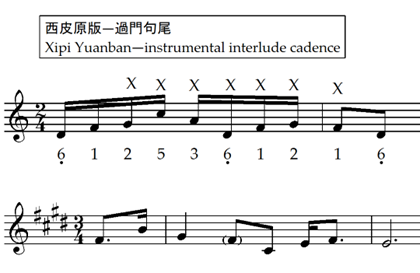
Structurally, the music in Chinese opera comprises of cycles of musical phrases. Each musical section is constructed around two verses of texts with the basic form of “percussion/instrumental introduction—verse one—instrumental interlude—verse two—instrumental conclusion.” The interlude is called guomen 過門 [crossing the threshold]. Although, with improvisations from both the singers and the instrumentalists, the renditions in live performances can vary greatly, the basic melodic and rhythmic patterns in each section are predetermined. While the lead-in might vary slightly, the standard ending phrase of xipi yuanban guomen is as follows:[21] The numbers below the notes refer to scale degrees in F.

Zhao used the final notes of this melody for his refrain. Here are the cadential notes and Zhao’s application in the first stanza (mm. ’16-18):

In performance practice, a second degree note (g) is often added between the a and the d in the guomen. Zhao apparently modeled after this variant. For the ending of the second stanza (mm. ’34-36), the melody is moved up to B major and the interval between the two notes was widened. The third stanza is a third higher than the first one. In the final phrase of the song, the refrain starts in the lower register and leaps up to end an octave higher than the first stanza.

__Violin obbligato

In a brief English introduction in the revised edition of Xinshi geji, Zhao wrote: “This new edition introduces some changes in the explanatory notes and the accompaniments, including the addition of a violin obbligato in Song No. 11, previously used in a Pathé-Columbia Recording No. 24828.”[22] From this statement, we learned that the violin obbligato was not included in the original version but was created before 1936.

__Interpretation

Zhao Yuanren was a true Renaissance man of many talents. His delivery of “Jiao wo ruhe buxiang ta” was not a brilliant display of vocal skills but a sincere reflection of his artistic intention. One hears frequently slight portamenti between notes. The effect is closer to Chinese folk song singing than western bel canto style vocal production.

Twice (m. 50, on 兒 and m. 71, on 何) he used a small downward arrow to indicate a slide of pitch. He then suggested in his notes that, when singing this song, it would be most important to keep it smooth and sweet. If necessary, portamenti could be applied, marked or not.

__Postlude

When Liu Bannong passed away in 1934, Zhao eulogized him with a poem:

十載湊雙簧,無詞今後難成曲;
數人弱一個,教我如何不想他。

Partnering for ten years in our shuanghuang act,
hereafter, it would be hard to create songs without verses;
“Gathering of Several” deprived of one, how can I help but think of him.

雙簧 shuanghuang is a two-man comic act in which one acts out the plot and the other provides verbal interpretations in words or in songs. The actors must have great chemistry with each other. In a few words, Zhao indicated that he not only lost a creative partner but also a confidant. He quietly addressed their collaborations on the linguistic reform. And, finally, the one song that was close to their hearts.


[1] The translation “Songs of contemporary poems” was taken from the second, revised edition (Taipei, 1960)
[2] All the English titles are taken from the list in the revised edition (Taipei, 1960). https://goldfishodyssey.com/2022/08/17/musical-settings-ii-words-tones-and-music/
[3] The first section of “Ping hua” was set to the seven-character jueju 七言絕句by Fan Chengda 范成大 (1126-1193). The words of the second section were written by Hu Shi. https://en.wikipedia.org/wiki/Fan_Chengda
In the Preface (譜頭語), Zhao indicated that, with the exceptions of “Crossing the Indian Ocean 過印度洋” by Zhou Wuruo 周無若 and “Ballad of the Cloth Vender 賣布謠” by Liu Dabai 劉大白, the poets consented to provide their words as song lyrics. Hu Shih had some reservation about his text “Ta 他” for its outward naiveté. The words of “Lao‘dong ge 勞動歌“ [Workmen’s Song] was an anonymous poem included in a collection of plain-language poetry Baihua shixuan 白話詩選, originally appeared in the journal Xingqi pinglun 星期評論 [Weekly Review].
“本集的歌詞的選擇,大部分是原著者贊成給這幾首作歌而作的,只有一首《他》胡適之先生嫌他太幼稚了,我說我做的這點音樂也幼稚,橫豎是個 scherzando 的玩意兒,就放進去讓 “他” scherzando scherzando 罷。還有《勞動歌》是在《白話詩選》裡看見的,上頭載的是見《星期評論》,但是我查了好久也沒有查出原著者是哪一位,所以沒有機會跟原著者商量。還有寫《過印度洋》的周無若先生跟寫《賣布謠》的劉大白先生我也沒有找到通信的路徑,所以不曉得兩位覺得我這音樂把他們的詩做好了還是做壞了。”
[4] This statement refers to the musical structure of German Lieder—solo voice with piano accompaniment, and the closeness between words and music. Zhao never intended to imitate the sounds of Schubert or Schumann.
[5] The original English title, likely by the composer himself, was “How Can I Help Thinking of You?”
[6] Liu’s given name at birth was Shoupeng 壽彭. Bannong 半農 (or 半儂) was his courtesy name.
[7] Liu Bannong, “Wo de wenxue gailiang guan 我的文學改良觀” [My thoughts on literary reform], New Youth 《新青年》, vol. 3, no. 3 (May 1917).  我的文學改良觀_zh.wikisource.org
[8] Liu Fu, Sisheng shiyan lu 《四聲實驗錄》 (Shanghai, Qunyi Bookstore 群益書社, March 1924) was based on Liu’s dissertation “Étude Expérimentale su les Tons du Chinois.” The French text was published in Paris in 1925. It was the earliest linguistic/acoustic studies in tones of Chinese language. For his experiments, Liu designed and built special devices “乙一聲調推斷尺” (Yǐ-one tone measurement ruler) and “乙二聲調推斷尺” (Yǐ-two tone measurement ruler) to measure the length and pitch of the tones. The terms “乙一” (Yǐ-one) and “乙二” (Yǐ-two) refer to different methods of testing.
劉復, “聲調之推斷及「聲調推斷尺」之製造與用法,” 中央研究院 《歷史語言硏究所集刊》第1本, 第2分 (1930): 131-164. https://www1.ihp.sinica.edu.tw/Publications/Bulletin/848
劉復, “乙二聲調推斷尺,” 《歷史語言硏究所集刊》第04本, 第4分 (1934): 355-361. https://www1.ihp.sinica.edu.tw/Publications/Bulletin/241
[9] Liu Bannong came from a musical family. his brothers Liu Tianhua 劉天華 and Liu Beimao 劉北茂 were both skilled performers of erhu 二胡 and well respected for their contribution to Chinese music. Liu_Tianhua_Wiki, Erhu_Wiki
[10] The name “Suren 數人” was taken from the Preface of Qieyun 切韻, the rhyme dictionary, in which the author Lu Fayen 陸法言 recounted his casual conferencing with like-minded colleagues around 583-585 AD, and how they, having dealt with all linguistic divergences, decided to set the ground rules of pronunciation.
昔開皇初,有劉儀同臻、顏外史之推、盧武陽思道、李常伺若、蕭國子該、辛咨議德源、薛吏部道衡、魏著作彥淵等八人,同詣法言門宿。夜永酒闌,論及音韻。古今聲調既自有別,諸家取捨亦復不同。吳楚則時傷輕淺,燕趙則多涉重濁;秦隴則去聲為入,梁益則平聲似去. . . 因論南北是非,古今通塞,欲更捃選精切,除削疎緩。 顏外史、蕭國子,多所決定。 魏著作謂灋言曰,『向來論難,疑處悉盡。何爲不隨口記之。』『我輩數人定,則定矣。』 灋言卽燭下握筆,略記綱紀。
[11] Gwoyeu_Romatzyh_Wiki
[12] The first (Upper) part of Yang-bian ji 揚鞭集 consisting of Liu’s poems from 1917 to 1920 was published in June 1926 by Beixin Bookstore 北新書局. The second (Middle) part containing works from 1921 to 1925 was published in October of the same year. There might have been plans for a third (Lower) part which was never completed. 教我如何不想她 (pp. 90-92) was the last work in the Upper part. In Xinshi geji, the traditional 他 was used in the title.
[13]Chao Yuen Ren, “Chinese linguist, phonologist, composer and author: oral history transcript “ by Rosemary Levenson (1974-1977): 107 Rosemary_Levenson_Interview_calisphere_#Y.R. Chao as Composer and Singer
[14] Chinese_Poetry_XVI_goldfishodyssey
[15] The original verse reads: 微風吹動了我的頭髮. The possessive particle 的 is omitted in Zhao’s setting.
[16] https://www.youtube.com/watch?v=UceaEkSnAGk Zhao Yuanren singing “Jiao wo ruhe buxiang ta”
[17] Xinshi geji, “Geci duyin 歌詞讀音” [Pronunciation of lyrics], 54: “. . . 比方當副詞用的還字, 非但在北京, 連南官話當中也有“韓”, “孩” 的讀法, 讀作“還原”的“還” (hwan) 音太不自然了. 在這個歌集, 我就取“韓”音作為折中的讀法. . ..”
See also Musical_Settings_III_Diction_goldfishodyssey, Literary vs colloquial.
[18] Xinshi geji, “Gezhu 歌註” [Commentary on songs], 64.
[19] Jinghu_(instrument)_Wiki, https://omeka-s.grinnell.edu/s/MusicalInstruments/item/641
[20] Paiban_Wiki
[21] This is a common version for male singers. The melodic lines will be elaborate for female singers.
YouTube__Xipi Yuanban excerpt from Guanlu si 甘露寺
YouTube_The above excerpt in numerical notation
For further reading on xipi and erhuang: Huang Jinpei, “Xipi and Erhuang of Beijing and Guangdong Operas,” Asian Music, Vol. XX, no. 2 (1989): 151-194.
[22] See note 16.

Musical Settings (VI): Xiao Youmei 蕭友梅 and Yi Weizhai 易韋齋

This entry is part 28 of 38 in the series Chinese Art Song

After setting “The Great River Flows Eastwards 大江東去” by Su Shi 蘇軾 to music in 1920, Qing Zhu 青主 focused on his political career and did not write any new works until the early 1930s. Meanwhile, as part of the cultural reform movement, other western-educated composers began creating songs with newly written lyrics. Xiao Youmei 蕭友梅 (1884-1940) and Yi Weizhai 易韋齋 (1874-1941) were pioneers of such works.

Xiao received his music education first in Japan (1901-1909) and later in Germany (1912-1919).[1] With a firm conviction of the power of music as a medium in character building, he devoted his time and effort in promoting music education after returning to China. While in Beijing, he founded and led the Music and Physical Education Department of Beijing Women’s Higher Normal College 北京女子高等師範學校 (1920), The Music Training and Research Institute affiliated to Beijing University 北京大學附屬音樂傳習所 (1922), and Music Department at Beijing National Arts College 北京國立藝術專門學校音樂系 (1926).[2] With the support of Cai Yuanpei 蔡元培, Xiao established the National Conservatory of Music 國立音樂專科學校—today’s Shanghai Conservatory of Music—in Shanghai in 1927.

Keenly aware of the need for teaching materials which were suitable for Chinese students in modern time, Xiao joined forces with lyricist Yi Weizhai to create songs, using Western harmony and newly written words. Jinyue chuji《今樂初集》 [First Collection of Todays Music] (1922) and Xinyue chuji 《新樂初集》 [First Collection of New Music] (1923) were the results of their collaboration.

___Yi Weizhai 易韋齋 (1874-1941)[3]

Born Yi Tingxi 易廷熹 on March 13, 1874, in Heshan, Guangdong 廣東鶴山, Yi received his early literary training at Guangya Academy 廣雅書院and was a disciple of phonologist Chen Li 陳澧.[4] After attending Aurora University 震旦書院[5] in Shanghai briefly, he went to Japan, studying languages and education.[6] A litterateur, Yi was also gifted in painting and calligraphy, and was especially known for his seal carving 篆刻.

Yi Weizhai and Xiao Youmei both studied in Japan during the first decade of the twentieth century and were active in revolutionary movements led by Sun Yat-sen.[7] After the Xinhai Revolution in 1912, they both held secretarial positions at the Presidential Office of the Provisional Government of the Republic of China in Nanking.[8] Their paths crossed again in the 1920s in Beijing where they were both teaching at various higher education institutions.[9]

Xiao was known for his uncompromising integrity and professionalism. Yi, on the other hand, despite his talents and knowledge, handled daily affairs and his career with a laissez-faire attitude. Their mutual interest in creating new style lyrics and songs brought them together.[10] Xian’s niece Xiao Shuxian 蕭淑嫻 recalled that, her uncle and Mr. Yi bought a small house in the western suburb near the Summer Palace 頤和園 as their pied-à-terre and studio. During summer months, each occupying one room, Yi wrote the lyrics and Xiao composed the songs and the piano accompaniments. Every time they completed two or three songs, they would bring the new works back to the city, asking friends and relatives to try them out.[11]

___Jinyue chuji《今樂初集》

Jinyue chuji, the first collection of the Xiao-Yi collaboration, was published by the Commercial Press in October 1922 and reprinted in November of the following year.[12] Among the twenty selections, three of them were for two-part chorus; three for three parts. The last four pieces were about women’s education and empowerment.

With the exception of a forward by Huang Jie 黃節[13], the entire volume, including the front-page art, music scores and texts, was hand-crafted by Yi Weizhai: the texts were in traditional calligraphy; the music in western staff notation. It was then produced using photographic printing process. On the one hand, it exposed the challenges that all the proponents of western music in China encountered during this period. On the other hand, it showcased the modernized printing technology which was instrumental in advancing new cultural development.

To fully appreciate the concept and the content of this collection, it is necessary to examine both the Preface and the Editorial Summary, both written by Yi in Classical Chinese:

Preface

I believe that our musical culture has never been declining more than the present day. Our forefathers educated people in three sets of disciplines— [six virtues, six principles of conduct, and six skills][14], music was one of the six skills. Ancient books were largely comprised of rhymed verses. It was understood back then that [musical] sounds were derived from one’s heart, without meaningless differentiation between social classes. In later times, cultivated music was monopolized by the ruling class. For the commoners, music was lessened to folk tunes. The literary creations of poets, henceforth, could not all be set to music. On the other hand, impertinent songs with plebeian texts proliferated and spread all over the country. The inundation causes one to feel nothing but sad and fatigue. I came to the north last year and reconnected with Mr. Xiao Youmei who invited me to write short lyrics. He then set them to music. The works were rather amicable. Therefore, we taught them to the students at the Beijing Women’s Higher Normal College. The effect was quite elegant and lovely. So, we continued the work and resulted in a number of pieces. Mr. Sun Zhong 孫壯[15]from Da Xing 大興noticed and appreciated them. Through his firm, the Commercial Press, he photo-engraved the works to share with teachers nationwide. I named this collection “The First,” as to carry on, and to gather comments for expansion and improvements. As I and Mr. Xiao each completed our editorial work, I, thus, encapsulated the essence of the collection.
___In the year of rénxū,[16] Yi Weizhai

弁言

吾以為樂之銷沈,未有甚於此時者也。前人以鄉三物 [六德、六行、六藝][17] 教民,樂為六藝之一。古書多有韵之文,其時知聲由心生,無上下貴賤妄生分别。後世樂私於君,下此者夷於謠諺,詩人文之,乃不能盡被弦管,而謠肆之聲、僿俚之辭,起而徧國中,横流第使人哀乏矣。余年前北來,重值蕭君友梅,約為短歌,君譜之聲。甚龤,乃以授北京女高師諸生,無甚婉渺,由是繼作,遂得如干首。大興孫君壯,見而善之,介其商務書館,得而影印,以餉海內教席。余謂此為初桄,賡此而起,又弥思增善也。今與蕭君各自寫㝎[18],略其概於此。
___壬戌 易韋齋

Editorial Summary

1. The majority of works in this collection are suitable for applications in middle schools and above. For higher primary schools, public schools, elementary schools, etc., there will be further editions to be published subsequently.

2. Lyrics and music in this collection are all newly composed. Old sources were referenced but not plagiarized.

3. In our country, graduates from secondary schools and junior normal colleges were often afraid of being singing teachers. And there were many of them who could not read music. This was because when they were in school, even though there were music courses, there were, unfortunately, no appropriate instructional materials. Hence their instructors frequently used English songs and texts. This was a big mistake. Students surely were not yet able to comprehend the meaning of the texts thoroughly and to pronounce the words accurately. Using such materials, how would it be possible to arouse their interest in singing[?] Mindful of such mistakes, the songs in this collection are written in Chinese only, so that students will not waste effort on language barriers, thus can be more focused and benefit more effectively.

4. Occasionally, idioms and historical references are used in the lyrics of this collection. Originally, we planned to provide annotation for each of them. Yet, since there were no obscure or incomprehensible references, and due to publication deadlines, this task, therefore, would wait until a later time.

5. Lyrics do not have to be restricted by rhymes but should never be without rhymes. Applications of rhymes in the texts of this collection were done with scrutiny and intense care. Those who recognize such efforts would certainly appreciate it.

6. Incorrect interpretation of the texts of songs will lead to misunderstanding. Hopefully, the public will interpret them correctly and critique them with a righteous attitude.

7. In music scores, to accommodate singers, words are dispersed and placed near the notes; thus, disrupting the structure and flow of sentences and verse, making it inconvenient to the literary aficionados. Therefore, the lyrics are gathered in a separate attachment at the end of the collection, ready to be examined by literary connoisseurs.

8. [descriptive], [comparative], xing [derivative] were three of the six disciplines of classical poetry. Each song text in this collection is also based on these three approaches and carries subtle nuances. Metaphorical admonitions concealed in the verses are mostly gentle satires. Instructors and students both can obtain the messages by associating the words with current events.

9. Currently, the music in the song collections used in our schools are mostly based on foreign tunes. Since most lyricists are not familiar with musical applications, verses often do not match musical phrases. This is one of the major reasons that elementary and middle school students lack interest in singing courses. The music in this collection was composed based on the meaning of the verses. Naturally, there will be no conflicts between music and words.

10. Our traditional music always favored minor scales; therefore, the sound was often melancholy. If we wish to enhance our music, we must move to using major keys (major scales). Because their sounds are uplifting and exuberant, easily making one feel excited. Following this logic, this collection uses only major keys in the scoring. Except for #F and bG, the other eleven keys were all included in the music. This can also offer students opportunities to practice key identification and notation. As for music in minor keys, they will be used later in future collections.

11. The musical contents of this collection are, tentatively, organized by categories. When used in teaching, one should arrange the order, taking into account the students’ level. In general, songs with longer texts (such as “Tang Shan,” “Benyuan,” etc.) and songs in which the vocal lines do not match the accompaniments (such as “Years”) should be taught last. For students who are not able to identify keys, naturally, pieces in keys with fewer flats and/or sharps should be taught first; ones with more signs later. Before students are familiar with one key, it is not suitable to teach them a second key—to avoid confusion.

12. “Poetry is to convey one’s aspiration.” Therefore, when singing a piece, it is necessary to be able to express the meaning of the lyrics. On the upper left corner of each song in this collection, expression terms (such as “majestic,” “joyful”) are given. We hope that the instructors will pay special attention to these terms.

13. The performance tempos differ from song to song. In this collection, following the expression terms, a tempo range (such as ♩ = 60, ♩ = 80) is marked. Please be mindful of these markings.

14. Currently, [western-styled] music in our country is still in its infancy. Most singers do not like accidental half-steps (or modulations). This is due to a lack of practice. In order to ease into chromatic singing, modulation only occurs in the second section of “Tang Shan.” The other pieces are all sung in the original key throughout. Pieces with chromatic applications will gradually increase in later productions.

編輯大意

一. 此集大部分,是適用於中等以上學校[;] 高小、國民、蒙學、各校,以次編箸,相繼出版。

二. 此集歌、曲, 俱是創作,用古有之,襲舊則無。

三. 我國中學,及初級師範畢業,往往憚於為唱歌教授,並多有未諳看譜者。其故由於在校時,雖有此科,苦嘸適當教材。乃其教之者,恆授以英文歌詞,是大謬也。學者於歌意,固未滲透解,即發音亦未能準確,執此教材,如何能引起唱歌興味[?] 今編此集,鑑此謬誤,特純用國文成歌,冀學者不他鹜而收實益。

四. 本集歌詞中,間有成語、及古事。本擬一一注出,但尚無奧僻難解者,以出版時間關係,此事遂俟異日。

五. 歌不必執泥於韵,但萬不能無韵。本集歌詞,用韵極攷核斟酌,識者玩之。

六. 歌之詞句,若加曲解,必生誤會。幸世人以正確之眼光觀之,以端嚴之態度,批評之,繩糾之。

七. 譜中歌詞,取便唱者,依音注字,歌之形式遂亡。專玩歌詞者,頗感不便。因別附歌集一束於後,備嗜文辭者鑒焉。

八. 賦、比、興,為詩六藝之三。本集各歌,亦體此三藝,均有弦外之意。主文譎錬,所謂婉而諷者居多。教者學者,均可於其時其事二者加之領會,則得之矣。

九. 現在吾國學校,所用歌集,其曲譜多採自外國。苐填詞者,多非諳樂理之人,致詞句每於樂句,不能針對。此亦為吾國中小學生對於歌唱一科,興味缺乏之一大原因。本集曲譜,純是比按歌意,創作而成[。] 自無詞曲互舛之處。

十. 吾國固有樂曲,向來善用小音階,故其聲多萎靡不振。欲改良吾國音樂,非改用大調不可 (即大音階)。以其聲多發揚蹈厲,易令人興起也。本集即根據此理,純用大調製譜。除大 #F 大 bG 兩調外,餘十一調,均以之入譜。藉此又可以與學者以練習辯調記譜之機會。至於小音階曲譜,當於次集以後用之。

十一. 本集內容,暫依歌之種類為次序。教時[,] 當依學生之程度,斟酌先後。大約較長之歌詞,(如湯山、本願 等) 及歌曲與伴奏不同者,(如 [年] 之類) 均應最後教授。對於未能辯調之學生,自應先授調號較少之曲,調號多者均應緩授。至於學生未認熟甲調之先,不宜即授乙調,防混亂也。

十二. 詩以言志,故凡唱一曲,須能將歌中含意,發表出來。本集各歌之左端,均用表情術, (如雄壯、喜樂、之類) 標明於上。希望教者,特加注意。

十三. 各歌唱奏,速度不一。本集於表情術語之後,即記明速度標準 (如 ♩ = 60, ♩ = 80 等) 亦希望注意。

十四. 吾國音樂,現尚幼稚,歌者多不喜臨時唱半音 (或轉調)。此皆由於缺少練習之故。本集為逐漸輸入唱半音起見,只於 [湯山] 歌,第二段轉調。餘均用本調歌唱,俟續出再以次增加此項有半音之歌曲。

Having spent years in Japan, both Xiao and Yi would have been familiar with “school songs” 學堂樂歌 created by Zeng Zhimin 曾志忞 (1879-1929), Shen Xingong 沈心工 (1870-1947), and Li Shutong 李叔同 (1880-1942).[19] Although some of these educational songs were written by the musicians, most of them were adaptations of existing western or Japanese songs, fitted with Chinese words. While they both wished to make singing a crucial part of secondary school curriculum, they disagreed with borrowing foreign music and words. Hence, they created a collection of new school songs with western-styled music and new-style lyrics.

As a poet, Yi favored the works of Liu Yong 柳永 and Wu Wenying 吳文英—both representatives of the wanyue 婉約 [delicate and demure] style of the Song Dynasty. He was known to have followed the versification in their works, especially the tone patterns, strictly in his own poems. [20] The literary contents in Jinyue chuji, the front matter narrations and the lyrics, were clear indications that Yi was not able to shake off the traditional influences even when attempting to create new-style works. The song texts were caught between Classical verses and plain language, difficult to understand and awkward to sing.

Despite its initial success, Jinyue chuji quickly faded into history. The songs in the collection were mostly forgotten. Critics often blamed Yi’s lyrics for this outcome. Nonetheless, as the music in the collection was written to fit the words, the composer should be equally responsible for the results.

As Yi mentioned, western-style music was in its infancy when the collection was written. One could also relate to the need to introduce the theory and practice to the students step by step. Avoiding minor keys all together so that the music would be uplifting and moral-strengthening seemed to be an extreme approach. Staying in one key throughout each song would certainly limit the emotional transitions and development.

Xiao’s music writing was also problematic. While simple melodies without chromatic patterns were convenient for beginners, they were, in most cases, not very interesting. The melodic contour often did not reflect the linguistic tones; the key words in the verses did not match the rhythmic stresses. Perhaps because of Xiao’s contribution to music education in China, there had been scarcely any negative commentary on his composition. In recent years, critics such as Meng Wentao began wondering, based on the disconnection between the lyrics and the musical contents, whether some of the melodies in the Xiao-Yi collections were composed first, and the words were fitted later.[21]

Jinyue chuji was followed by Xinyue chuji 《新樂初集》 (1923), a twenty-five-song collection based on the same editorial format, and three volumes of teaching materials including sight-singing exercises, entitled Xinxuezhi changge jiaokeshu 《新學制唱歌教科書》 [Singing Textbooks for the New School System] (1924).[22] From today’s point of view, the Xiao-Yi collections lack artistic value. As historical testaments, they reflect the struggles of intellectuals, individually and collectively, in a country striving to move away from traditions and finding its footing in the modern world.

When Xiao Youmei established the National Conservatory of Music in Shanghai in 1927, Yi joined the faculty, teaching Chinese and poetry. Together, they influenced a new generation of composers and lyricists.


[1] With a dissertation entitled, “Eine geschichtliche Untersuchung über das chinesische Orchester bis zum 17. Jahrhundert (Historical Research on the Pre-Seventeenth Century Chinese Orchestra),” Xiao received his Ph.D. at Königliches Konservatorium der Musik zu Leipzig (now Hochschule für Musik und Theater “Felix Mendelssohn Bartholdy” Leipzig) in 1916. He was the first Chinese student to obtain a doctoral degree abroad.
[2] In older references, “Peking” would be used instead of “Beijing.”
[3] In addition to Weizhai 韋齋, Yi had an unusually long list of art names and aliases including Xi 熹, Ru孺, Ziru 子孺, Daan 大厂 (大庵), Daan jushi 大庵居士. This poses a challenge in consolidating references in his life and achievements. The name Xi熹 appears often in references on his work as a painter, calligrapher and seal maker uses the name; for his literary works, Weizhai 韋齋 or Daan 大厂 (大庵).
[4] Guangdong_Guangya_High_School_Wiki, Chen_Li_(scholar)_Wiki
[5] Aurora_University_(Shanghai)_Wiki
[6] The exact timeline of Yi’s educations was not clear. However, he would have been at Aurora University after 2003 and have completed his study in Japan by 1912 around the time of Xinhai Revolution.
[7] Xiao joined Tongmenghui 同盟會 and worked closely with Sun. Yi became a member of Nanshe 南社 [South(ern) Society], a literary society founded by members of Tongmenghui.
Tongmenghui_Wiki
South_Society_Wiki
[8] Provisional_Government_of_the_Republic_of_China_(1912)_Wiki
[9] Yi taught at [Beijing] Higher Normal College 北平高等師範 and The Music Training and Research Institute.
[10] Long Muxun 龍沐勛, a younger contemporary and colleague of Xiao and Yi, gave vivid accounts of their lives and works in his articles, Yuetan Huaijolu 樂壇懷舊錄 [Nostalgia of Music World]. Qiushi Monthly 求是月刊, vol. 1, no. 2 (1944): 16-19 and Yuetan Huaijolu 樂壇懷舊錄續 [Nostalgia of Music World Continued]. Qiushi Monthly 求是月刊, vol. 1, no. 4 (1944): 18-25.
[11] Xiao Shuxian 蕭淑嫻, “Hueiyi wode shufu Xiao Youmei: Xiao Youmei de jiating han tade yoxue shenghuo” 回憶我的叔父蕭友梅:蕭友梅的家庭和他的遊學生活 [Remembering My Uncle Xiao Youmei: Xiao Youmei’s Family and His Academic Life], Wenhua shiliao cóngkang 文化史料叢刊, vol. 5 (1983): 32.
[12] Since its founding in 1897, the Commercial Press 商務印書館, has grown into one of the most influential private enterprises in both industrial and cultural advancements.
The_Commercial_Press_Wiki
http://www.cgan.net/book/books/print/g-history/big5_12/14_1.htm 中華印刷通史, 近代篇
[13] https://zh.wikipedia.org/zh-hant/黃節
[14] The three disciplines were not listed in Yi’s original text. The three sets of disciplines were explained in Zhou li, Diguan Situ [The Rites of Zhou, Offices of Earth]. 周禮/地官司徒: 以鄉三物教萬民而賓興之:一曰六德,知、仁、聖、義、忠、和;二曰六行,孝、友、睦、姻、任、恤;三曰六藝,禮、樂、射、御、書、數。
[15] Sun Zhong 孫壯 (1879-1943), courtesy name Boheng 伯恆, was, at the time, the manager of the Beijing branch of the Commercial Press.
[16] The year of 1922, Sexagenary_cycle_Wiki. 1922 was an important year of National Education Reform. A new school system, known as Renxu School System, was implemented to extend the years of schooling—six years of primary school; three, lower secondary and three, upper secondary, and to strengthen vocational and science education.
https://en.wikipedia.org/wiki/6-3_school_system
https://zh.wikipedia.org/zh-tw/壬戌學制
[17] See note 13.
[18] 㝎=定
[19] The Call of Modernity: Chinese School Songs in the Early Twentieth Century, by ZhiZhi Li.
[20] Long, Yuetan Huaijolu, 21-22.
Liu_Yong_(Song_dynasty)_Wiki
https://cuhk.edu.hk/rct/renditions/authors/wuwy.html
goldfishodyssey_chinese-poetry-ix-ci-lyric-verses
[21] Meng Wentao 孟文濤, Zhongguo jinxiandai gequ chuangzuoshi zhong yige teshu jinjian shili—Shiyi Xiao Youmei yu Yi Weizhai hexie gequzhong de ciqu jiehe wenti 中國近現代歌曲創作史中一個特殊僅見事例 [My Opinion About Xiao Youmei’s Art Song], Huangzhong, Journal of Wuhan Conservatory of Music 黃鍾, 武漢音樂學院學報, 2005 (2): 26- 30. The English title, not a direct translation of the Chinese one, was used in the English abstract.
[22] Xinyue chuji 《新樂初集》 was reprinted in October 1925. An edition with new print setting and a few changed in the front matters was brought forward in 1934. The “New School System” specification in Xinxuezhi changge jiaokeshu 《新學制唱歌教科書》 would have been the “Renxu System,” implemented in 1922. See note 15.