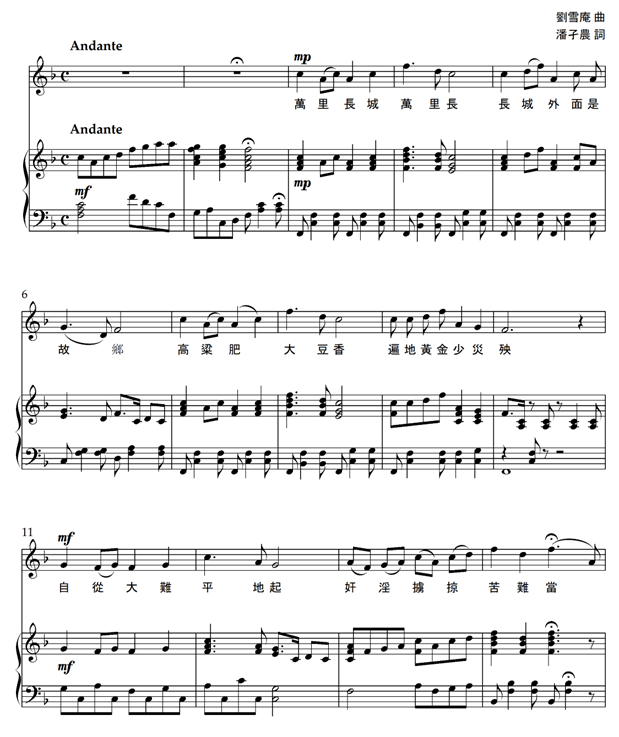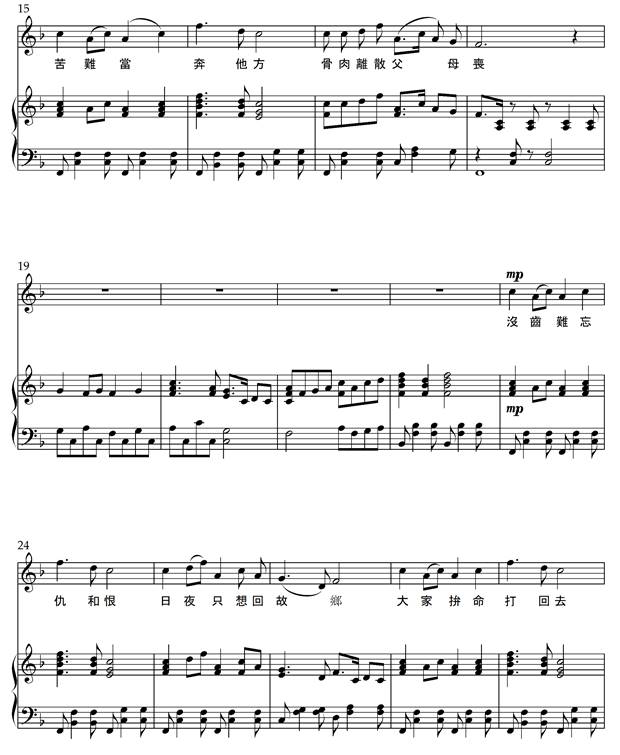
By the Songhua River 松花江上
Words and Music by Zhang Hanhui 張寒暉
我的家在東北松花江上,
[wo3 de5 jia1 zai4 dong1 bei3 song1 hua1 jiang1 shang4]
ㄨㄛˇ ㄉㄜ˙ ㄐㄧㄚˉ ㄗㄞˋ ㄉㄨㄥˉ ㄅㄟˇ ㄙㄨㄥˉ ㄏㄨㄚˉ ㄐㄧㄤˉ ㄕㄤˋ
My home was in the Northeast by the Songhua River,
那裡有森林煤礦,
[na4 li3 you3 sen1 lin2 mei2 kuang4]
ㄋㄚˋ ㄌㄧˇ ㄧㄡˇ ㄙㄣˉ ㄌㄧㄣˊ ㄇㄟˊ ㄎㄨㄤˋ
There were forests and coal mines,
還有那滿山遍野的大豆高粱。
[hai2 you3 na4 man3 shan1 pian4 ye3 de5 da4 do4 gao1 liang2]
ㄏㄞˊ ㄧㄡˇ ㄋㄚˋ ㄇㄢˇ ㄕㄢˉ ㄆㄧㄢˋ ㄧㄝˇ ㄉㄜ˙ ㄉㄚˋ ㄉㄡˋ ㄍㄠˉ ㄌㄧㄤˊ
Furthermore, Soybeans and sorghum grew all over the mountains.
我的家在東北松花江上,
[wo3 de5 jia1 zai4 dong1 bei3 song1 hua1 jiang1 shang4]
ㄨㄛˇ ㄉㄜ˙ ㄐㄧㄚˉ ㄗㄞˋ ㄉㄨㄥˉ ㄅㄟˇ ㄙㄨㄥˉ ㄏㄨㄚˉ ㄐㄧㄤˉ ㄕㄤˋ
My home was in the Northeast by the Songhua River,
那裡有我的同胞,
[na4 li3 you3 wo3 de5 tong2 bao1]
ㄋㄚˋ ㄌㄧˇ ㄧㄡˇ ㄨㄛˇ ㄉㄜ˙ ㄊㄨㄥˊ ㄅㄠˉ
There were my countrymen,
還有那衰老的爹娘。
[hai2 you3 na4 shuai1 lao3 de5 die1 niang2]
ㄏㄞˊ ㄧㄡˇ ㄋㄚˋ ㄕㄨㄞˉ ㄌㄠˇ ㄉㄜ˙ㄉㄧㄝˉ ㄋㄧㄤˊ
And my feeble parents.
********************
九一八,九一八,
[jiu3-yi1-ba1, jiu3-yi1-ba1,]
ㄐㄧㄡˇ ㄧˉ ㄅㄚˉ ㄐㄧㄡˇ ㄧˉ ㄅㄚˉ
9-1-8, 9-1-8,
從那個悲慘的時候!
[cong2 na4 ge5 bei1 can3 de5 shi2 ho4]
ㄘㄨㄥˊ ㄋㄚˋ ㄍㄜ˙ㄅㄟˉ ㄘㄢˇ ㄉㄜ˙ ㄕˊ ㄏㄡˋ
Since that sorrowful time!
九一八,九一八!
[jiu3-yi1-ba1, jiu3-yi1-ba1,]
ㄐㄧㄡˇ ㄧˉ ㄅㄚˉ ㄐㄧㄡˇ ㄧˉ ㄅㄚˉ
9-1-8, 9-1-8,
從那個悲慘的時候,
[cong2 na4 ge5 bei1 can3 de5 shi2 ho4]
ㄘㄨㄥˊ ㄋㄚˋ ㄍㄜ˙ㄅㄟˉ ㄘㄢˇ ㄉㄜ˙ ㄕˊ ㄏㄡˋ
Since that sorrowful time!
脫離了我的家鄉
[tuo1 li2 liao3 wo3 de5 jia1 xiang1]
ㄊㄨㄛˉ ㄌㄧˊ ㄌㄧㄠˇ ㄨㄛˇ ㄉㄜ˙ ㄐㄧㄚˉ ㄒㄧㄤˉ
Torn away from my homeland,
拋棄那無盡的寶藏,
[pao1 qi4 na4 wu2 jin4 de5 bao3 zang4]
ㄆㄠˉ ㄑㄧˋ ㄋㄚˋ ㄨˊ ㄐㄧㄣˋ ㄉㄜ˙ ㄅㄠˇ ㄗㄤˋ
Abandoning boundless treasures,
流浪!流浪!
[liu2 lang4, liu2 lang4]
ㄌㄧㄡˊ ㄌㄤˋ ㄌㄧㄡˊ ㄌㄤˋ
Wandering, wandering!
整日價在關內,流浪!
[zheng3 ri4 jie4 zai4 guan1 nei4 liu2 lang4]
ㄓㄥˇ ㄖˋ ㄐㄧㄝˋ ㄗㄞˋ ㄍㄨㄢˉ ㄋㄟˋ ㄌㄧㄡˊ ㄌㄤˋ
Wandering all the days south of the Great Wall.[1]
哪年,哪月,
[na3 nian2, na3 yue4]
ㄋㄚˇ ㄋㄧㄢˊ ㄋㄚˇ ㄩㄝˋ
Which year, which month,
才能夠回到我那可愛的故鄉?
[cai2 neng2 go4 huei2 dao4 wo3 na4 ke3 ai4 de5 gu4 xiang1]
ㄘㄞˊ ㄋㄥˊ ㄍㄡˋ ㄏㄨㄟˊ ㄉㄠˋ ㄨㄛˇ ㄋㄚˋ ㄎㄜˇ ㄞˋ ㄉㄜ˙ ㄍㄨˋ ㄒㄧㄤˉ
Can I return to my beloved homeland?
哪年,哪月,
[na3 nian2 na3 yue4]
ㄋㄚˇ ㄋㄧㄢˊ ㄋㄚˇ ㄩㄝˋ
Which year, which month,
才能夠收回那無盡的寶藏?
[cai2 neng2 go4 shou1 hui2 na4 wu2 jin4 de5 bao3 zang4]
ㄘㄞˊ ㄋㄥˊ ㄍㄡˋ ㄕㄡˉ ㄏㄨㄟˊ ㄋㄚˋ ㄨˊ ㄐㄧㄣˋ ㄉㄜ˙ ㄅㄠˇ ㄗㄤˋ
Can I reclaim the infinite treasure?
爹娘啊,爹娘啊。
[die1 niang2 a5, die1 niang2 a5]
ㄉㄧㄝˉ ㄋㄧㄤˊ ㄚ˙ ㄉㄧㄝˉ ㄋㄧㄤˊ ㄚ˙
Oh, father and mother; oh, father and mother,
什麼時候,
[she2 me5 shi2 ho4]
ㄕㄜˊ ㄇㄜ˙ ㄕˊ ㄏㄡˋ
When will be the time,
才能歡聚一堂
[cai2 neng2 huan1 ju4 yi4 tang2]
ㄘㄞˊ ㄋㄥˊ ㄏㄨㄢˉ ㄐㄩˋ ㄧˋ ㄊㄤˊ
That we can be reunited happily?
__”Songhua jiang shang”
“Songhua jiang shang” was written by Zhang Hanhui 張寒暉, a teacher at the Second Provincial Middle School of Xi’an 西安省立第二中學 in November of 1936. First sung and popularized by his students locally. As its nostalgic lyrics and sorrowful melody stirred up public sentiment, it spread rapidly nationwide. It is impossible to fully appreciate the content of the piece and its historical impact without examining its geographical and historical background.
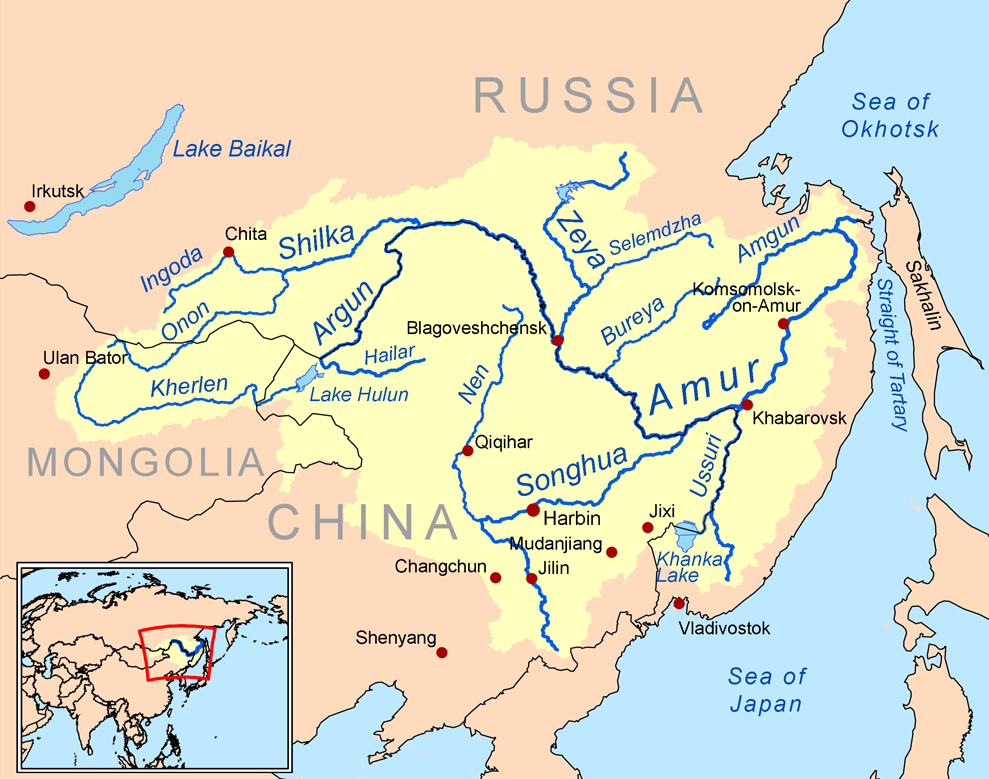
__The Songhua River[2]
The Songhua River is the longest tributary of Amur River (aka Heilong jiang 黑龍江, Black Dragon River, in Chinese territory). Flowing northward from Changbai Mountains 長白山 near the China-North Korea borders, it runs through the Northeast region of China, known internally as the Three Eastern Provinces (dong san sheng 東三省),[3] or commonly as the Manchuria. Geographically, the Songhua River travels through major cities such as Jilin and Harbin. Via Heilong River and railroads, it connects the region with Inner Mongolia and Russia. Economically, it is an artery for the transportation of the region’s agricultural commodities, oil and coal. The Songhua River is also admired for its natural beauty: Sprawling mountains in the area are natural habitats for virgin forests. Spectacular landscapes alongside the river and unique wintry scenery attract visitors from afar.
__Historical Background
During the Warlord Era following the overthrow of the Qing dynasty (1911-1928), the Northeast was controlled by the Fengtian clique 奉天軍,[4] led by Zhang Zuolin 張作霖.[5] In 1927, with the support of Japanese Imperial Army and other warlords, he became the last governor of the Beiyang government 北洋政府 in Beijing. Soon afterwards, realizing that JIA was only interested in the land and the rich natural resources of the Northeast, Zhang began resisting their demands.
The National Revolutionary Army of the Kuomintang (Nationalist Party, 國民黨)launched the Northern Expedition—a campaign to relegate the warlords and unify the country—in July of 1926 from Guangzhou.[6] Despite internal fragmentation, especially conflicts with the rising Chinese Communist Party, the NRA, under the leadership of Chiang Kai-shek 蔣介石, was able to conquer or incorporate regional armies and advanced northwards. On May 30, 1928, having been defeated by the expeditionary forces, Zhang Zoulin ordered the Fengtian clique to withdraw from Beijing, while the Japanese urged him to defend his dominance in the region. On his return to the Northeast, his train was blown up by the JIA on the morning of June 4 near Shenyang.[7]
After the assassination of his father, Zhang Xueliang 張學良 took over the command of Fengtian clique. A month later, he pledged allegiance to the Nationalist government. On December 29, 1928, his forces began flying the flags of the Republic of China. This event marked the end of the Warlord Era and, nominally, the beginning of a unified new China.[8]
The newly established government, centralized in its new capital Nanjing, faced a two-pronged challenge: Politically, the rising opposition from the CCP; militarily, the aggression of JIA. Focusing on demolishing the CCP and weakening other internal oppositions, Chiang took a passive approach towards Japanese invasion. After the Mukden (9-1-8) Incident, Zhang Xueliang ordered his forces to not resist and not engage in direct combat with Japanese Army.[9] This strategy allowed the JIA to engulf Northeast without heavy resistance.
As Japanese forces took over the Northeast, many civilians—mostly farmers—were forced to leave their homeland. Xi’an 西安, being the capital of Shaanxi Province 陝西省 in Central North China, quickly became a refuge for displaced people. Most of them struggled to maintain a livelihood.
After losing control of the Three Eastern Provinces, the majority of the Northeastern Army—the renamed and reorganized Fengtian clique—were deployed to Shaanxi in late 1933, headquartered in Xi’an. They were to join force with the Northwestern Army—a regional troop led by Yang Hucheng 楊虎城—in the anti-Communist war.
On the other side of the civil war, to avoid direct confrontation with Chiang’s forces, the Red Army split into several fronts in October 1934. Taking different routes and employing the tactics of guerrilla warfare, they reached northern Shaanxi a year later and set up their operational headquarters in Yan’an 延安, sixty miles north of Xi’an. Nevertheless, they lost many fighters and had limited resources to replenish their supplies.[10]
By late 1936, the city of Xi’an was crowded with transients, including refugees and families of military personnel. Opposition to the official “non-resistance” policy was widespread. The intensity of the discontent was escalated by student activism and influences from the CCP through their underground networks. In early December, Chiang Kai-shek arrived in Xi’an to pressure Zhang Xueliang and Yang Hucheng to take immediate military actions against remnants of the CCP forces.
On December 9, 1936, over ten thousand students in Xi’an took to the streets commemorating the one-year anniversary of student demonstrations in Beijing[11] and demanding action against Japanese aggressions. “Songhua jiang shang” was heard publicly for the first time on this day. Led by some faculty members, the students marched about ten miles west of the city to the resort Huaqing Pool 華清池, where Chiang stayed, wanting to deliver their plea directly to him. Zhang was ordered to handle the situation. Facing the huge gathering of students, he expressed that, sharing their wishes, he would not only relay their messages to Chiang but also respond to them in action within a week.
Underground members of the CCP had infiltrated all levels of the Nationalist organizations. Both Zhang and Yang, frustrated with Chiang’s dogmatic insistence, had been negotiating with the CCP secretly. Yang advocated for a military remonstrance to force Chiang to change his political and military approaches. In the early morning of December 12, Zhang and his associates arrested Chiang. Hours later, Zhang and Yang telegraphed the Nanjing administration. In addition to explanations of the reasons for their actions, they presented a list of demands. The most crucial among them were an immediate cease to the civil war and the establishment of a united KMT-CCP anti-Japanese front. Historically, this event, known as the Xi’an Incident, was a turning point in the Sino-Japanese conflicts. [12]
The initial combat rescue missions failed. Long and complicated negotiations involving the CCP and the Comintern proceeded. Chiang was finally freed on December 25 and returned to Nanjing, accompanied by Soong Mei-Ling and Zhang Xueliang. Shuffling of military powers in the north ensued, as the KMT and the CCP engaged in direct dialogue. Although the chasm between the two sides remained unresolved, an anti-Japanese alliance was formed, known as the Second United Front第二次國共合作.[13] The civil war was suspended until the end of WWII.
__Zhang Hanhui 張寒暉 (1902-1946)
Zhang Hanhui (1902-1946) was from a literary family in Ding County 定縣 of Hebei 河北 Province. Around the time of the May Fourth movement, while attending the Affiliated High School of the Normal College of Boading 保定師範附中, he became exposed to Marxism through New Youth 新青年 and Weekly Critic 每週評論.[14] In 1920, he left for Beijing. After a brief period of electrician training, he entered Beijing People’s Art Drama School 北京人藝戲劇專門學校, the first modern theatrical training college in China.[15]
1925 was a crucial year for Zhang Hanhui. He was accepted into the theater department at the National Beijing Art Academy, where he studied music with Zhao Yuanren 趙元任, focusing on regional theatrical traditions. Later in the year, he became a member of the CCP. To further the cause of communism, he joined the League of Left-Wing Writer in 1930, helping with the organization of theatrical groups.[16]
An activist of radical reforms, Zhang carried on his work among the commoners. Musically, he compiled yangko (秧歌, rice-sprouting songs) and other folk songs; composed farming and laboring songs; and created patriotic songs based on traditional melodies. Politically, he engaged in civic education and community organizations. In 1935,[17] he went to Xi’an and, as the Chinese literature teacher at the Second Provincial Middle School, began organizing anti-Japanese activities.
__Lyrics and music
Zhang Hanhui never visited the Northeast. Nevertheless, the lyrics of Songhua jiang shang vividly depicted the beauty of the region and the richness of its resources, giving reasons to the profound nostalgia of the protagonist. Without mentioning the enemies directly, the resentment against their aggression was palpable. The emotional impact of its first-person narration is incisive, especially at a time of national crisis.
Songhua jiang shang, composed within a short time under war-time conditions, was likely written to be sung unaccompanied and in unison with mixed voices originally. The musical structure corresponds to the poetic components. The opening sets of tercets, reminiscences of the landscape of the Northeast, were set to the major key. At the calls of 9-1-8, the tonality turned into minor mode. The melodic lines in the later sections, derived from the funeral lament, da bei tiao (大悲調, tune of extreme grief),[18] fluctuated widely. Zhang had in mind to imitate the mourning cries of women in the northeastern tradition.
__Performance History and Derivative works
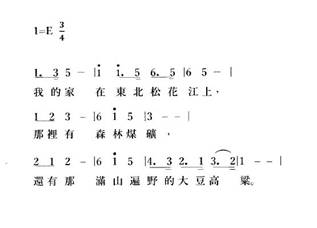
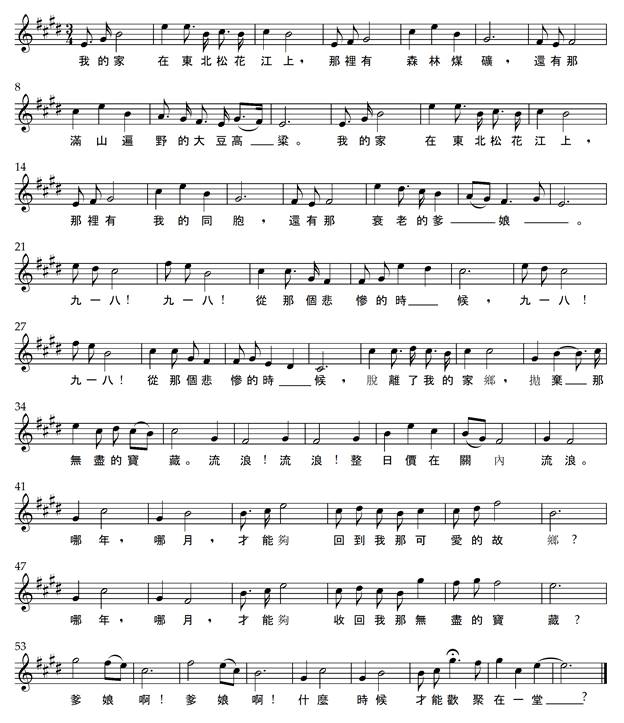
In the weeks and months following the creation of Songhua jiang shang, it was reproduced in the numbered notation (jianpu, 簡譜)[19] and systematically distributed by the networks of the CCP locally and across the nation, while the composer remained anonymous.[20] These “simplified scores,” still widely available today, manifest the original version of the song. In 3/4 throughout, the melodies flow steadily. However, as the lengths of verses vary, the phrasal structure and word placements seem erratic.
The opening lines of Songhua jiang shang in jianpu. Tonic (1) = E:
The original (choral) version, transcribed from jianpu—tonic = E:
One year after the creation of Songhua jiang shang, Liu Xue’an 劉雪庵 and Jiang Ling 江陵 created a three-part suite 《流亡三部曲》 (“Liuwang sanbuqu,” Three Songs of Exile), opening with Songhua jiang shang, followed by 《流亡曲》 (“Liuwang qu,” Song of Exile) and《復仇曲》(“Fuchou qu,” Song of Revanche). [21] Existing jianpu source demonstrated that Liu reset the opening section in 4/4 time, starting with the first two words on an upbeat. By doing so, he was able to iron out some word accentuation issues. He also rephrased verses 14 and 15 by inserting a 4/4 measure. In addition to some minor rhythmic changes, in the opening phrase, he lowered the fourth note for the word 在 zai to dominant, delaying the transition to a high note. Effectively, the emphasis landed on the words 東北 dongbei (the Northeast). The same pattern is repeated in verse four. Clearly, Liu valued the original work but noticed some compositional issues.
Transcription based on jianpu found in Kangzhangequji–Liuwangzhige 抗戰歌曲輯—流亡之歌 (1946)[22]
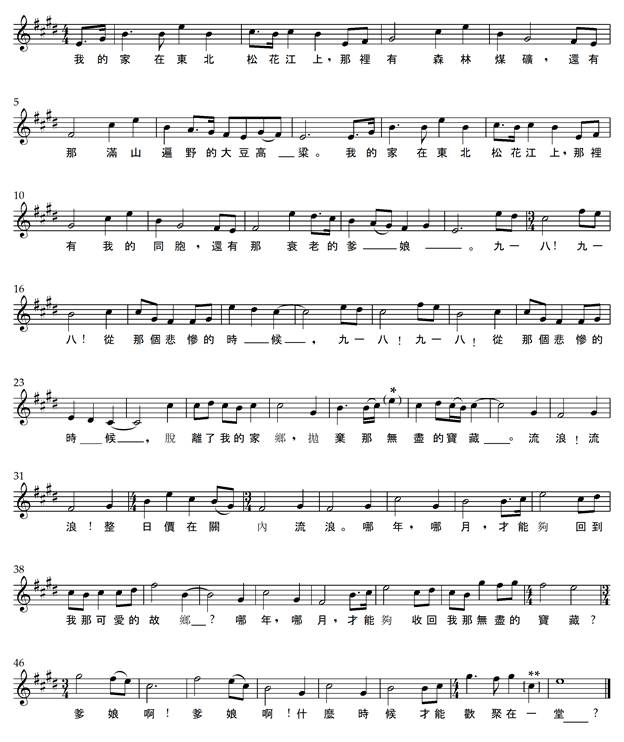
*Final note in m. 27 was invisible in the source notation.
**Final note in m. 52 was notated as a high tonic note which appears to be a misprint.
Liuwang sanbuqu was first published in 1938 in Zhange 戰歌, Liu Xue’an’s self-funded weekly publication of patriotic music . The three songs, as a set, were popular during wartime. Although Liuwang and Fuchou are still in limited circulation in jianpu, they are rarely heard today. On the other hand, Songhua jiang shang has become a frequently performed art song with piano accompaniment by later composers. This phenomenon is, at least partially, due to the political affiliations of the composers.
A concert version with piano accompaniment by Liu Yanlin 劉炎林 was included in the second volume of the Centennial Collection of Chinese Art Songs 中國藝術歌曲百年曲集, published by the Shanghai Conservatory.[23] The complementing piano introduction opens with the 9-1-8 motif and turns to fragments of the initial vocal line, providing an emotional backdrop for the storytelling. The occasional piano flourishes enhance the dynamic and emotional buildup. Largely parallel to the original choral version in 3/4 time, this arrangement borrowed Liu Shuean’s phrasing for verses 14 and 15.
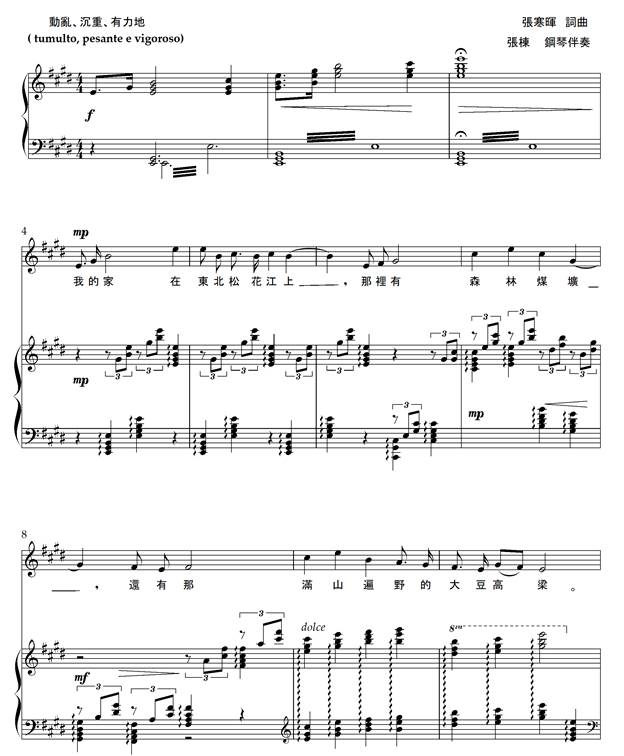
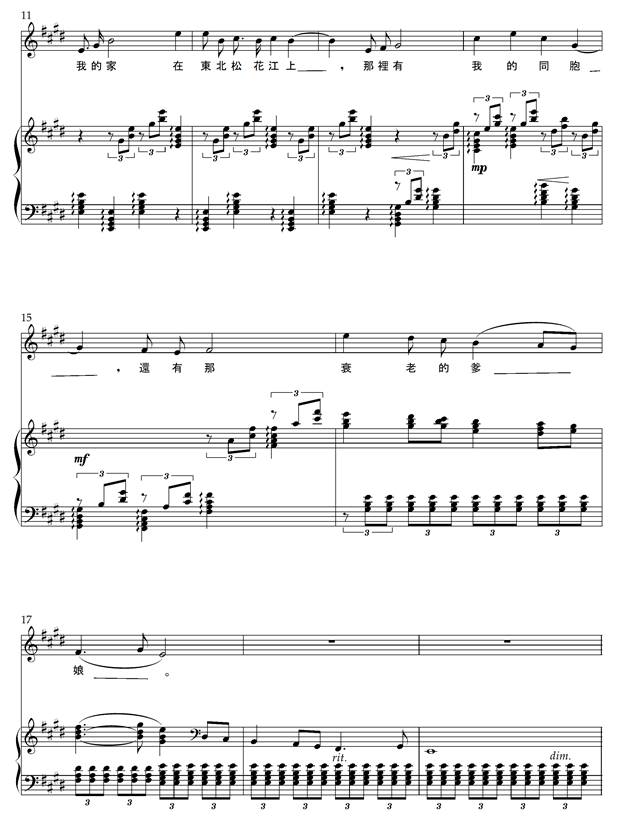
In their 2016 Chinese art-song recital, baritone Sheng Yang 沈洋 and pianist Yang Liqing 楊立青 presented a different—but more popular—version, arranged by Zhang Dong 張棟.[24] Contrary to Liu Yanlin’s edition, Zhang Dong followed the framework of the Liuwang sanbuqu version, with the first section in quadruple time and the later sections mostly in triple time. Zhang’s piano writing was idiomatic and more reflective of the emotional content of the texts.
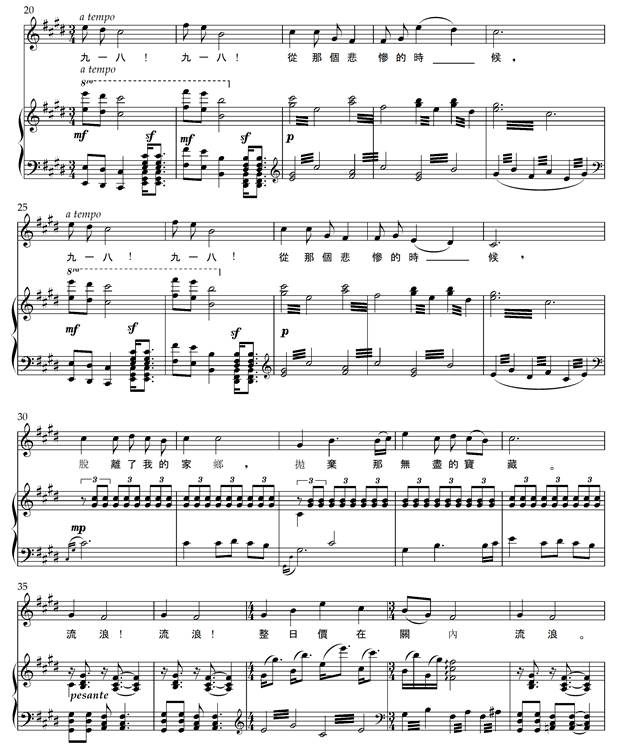
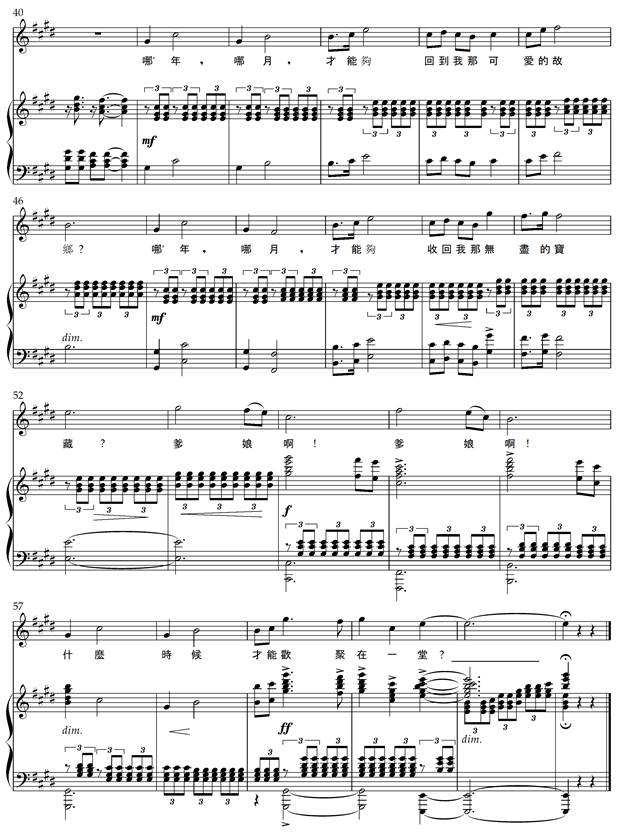
In 1964, for the celebration of the fifteenth anniversary of the founding of the People’s Republic of China, Zhou Enlai 周恩來 produced a large-scale theatrical work East is Red 東方紅. Songhua jiang shang was the opening number for the fourth act “Beacon of Anti-Japanese Resistance” 抗日的烽火.[25] Three years later, pianist Cui Shiguang 崔世光 composed a piano solo work based on the themes of Songhua jiang shang.
Due to its historical background and political impact, the song was banned in Taiwan during the martial law era (1949-1987). Later, it could be heard in the soundtrack of A City of Sadness 悲情城市, a 1989 film by Hou Hsiao-Hsien 侯孝賢, telling the story of a prominent family in the historical town Jiufen 九份 on the eve of the declaration of the martial law..[26] It also appeared in the 2015 TV series A Touch of Green 一把青, based on one of short stories in Taipei People 台北人 by Pai Hsien-yung 白先勇, describing the transient lives of mainlanders in 1950s.[27] These excerpts in popular culture gave a glimpse of how Songhua jiang shang permeated the Chinese psyche, even in the post-war era and on the other side of the Taiwan Strait. In recent decades, the entire Liuwang sanbuqu were often performed the choral concerts commemorating the end of Sino-Japanese war and, more importantly, the Japanese colonization.[28]
A wartime patriotic song transformed into a concert piece, Songhua jiang shang represents a new era in the development of Chinese Art Song. It is also one of the first songs to be censored politically. Its historical and social importance might outweigh its artistic merits.
[1] 關內 guan nei, within the pass, opposite of 關外 guan wai, outside of the pass, was an idiom, defining the territory west/south Shanhai Pass 山海關, an important strategic pass and the starting point of the Great Wall.
[2] Songhua_River_Wiki, http://rg21.jp/wp-content/uploads/Amurrivermap.png
[3] The three provinces are Liaoning 遼寧 (known as Fengtian 奉天 from 1907 to 1929), Jilin 吉林 and Heilongjiang 黑龍江.
[4] Fengtian_clique_Wiki
[5] Zhang_Zuolin_Wiki
[6] Northern_Expedition_Wiki
[7] Huanggutun_incident_Wiki
[8] Northeast_Flag_Replacement_Wiki; https://chinesehistoryforteachers.omeka.net/nanjing-decade-overview
[9] Mukden-Incident_Britannica
[10] Known as the “long march,” this military operation, strategized by Mao Zedong, solidified his leadership in the party. Long_March_Wiki
[11] The massive movement started in Beijing and quickly moved through other major cities. Though it was mostly organized by left-leaning students, the desire to protect the nation from foreign aggressors was felt strongly across the nation. December_9th_Movement_Wiki
[12] Xi’an_Incident_Wiki; 西安事變/zh.wikipedia.org/zh-tw/
[13] Second_United_Front_Wiki
[14] New Youth started as a platform for social and literary reforms. By 1920, it had become a sounding board for Communism. The internal conflicts among the CCP founding members eventually led to its demise. New_Youth_Wiki
Weekly Critic 每週評論 was co-founded by Chen Duxiu 陳獨秀 and Li Dazhou 李大釗 in 1918, promoting socialism. Hu Shi 胡適 was a frequent contributor and, briefly, editor. The magazine was shut down by Beiyang government in 1919 for its aggressive ideology. 每週評論/zh.wikipedia.org/zh-tw/
[15] 北京人藝戲劇專門學校/zh.wikipedia.org/zh-tw/
[16] League_of_Left-Wing_Writers_Wiki
[17] Some sources listed summer of 1936 as the date.
[18] Da bei tiao 大悲調 (or ku tiao 哭調, crying tune) is the generic term of funeral laments, often sung by female mourners or played onsuona 嗩吶—an extremely nasal sounding, high-pitched double-reed instrument. The exact melodies vary from region to region. https://www.youtube.com/watch?v=XTobbrJyji0, https://www.youtube.com/watch?v=3v_r94GQieA
[19] The numbered musical notation uses numbers 1234567 to represent the solfege syllables do-re-mi-fa-sol-la-si. It was heavily as an educational tool in China during the early twentieth century. Numbered_musical_notation_Wiki
[20] “一首抗日歌曲抵得上兩個師的兵力,” http://www.handandangshi.gov.cn/jinshen/1715.html
[21]Liuwang qu was also known as《離家》 (“Lijia,” Leaving Home); Fuchou qu, aka 《上前線》 (“Shang qianxian,” Going to the Battlefront). goldfishodyssey/musical-settings-xiv-art-songs-and-patriotism/
Kangzhangequj–Liuwangzhige 抗戰歌曲輯—流亡之歌, published by the 13th Army Group (National Revolutionary Army of KMT) on May 5, 1946. 抗戰歌曲輯—流亡之歌, Wikimedia Commons
[22] Kangzhangequj 抗戰歌曲輯,5.
[23] Liao Changyong 廖昌永 ed., Zhongguo yishu ghequ bainianquji, di er ji—fangxingweiai (中國藝術歌曲百年曲集,第二集—方興未艾, Collection of Chinese Art Songs in 100 years, volume 2), Shanghai Conservatory of Music Press, 2020. In the edition for high voices, Songhua jiangshang arranged by Liu Yanlin is found from p. 116 to p. 122.
[24] YouTube.com/Sheng Yang, Baritone & Yang Liqing, piano/2016
[25] The_East_Is_Red_(1965_film)_Wiki; 東方紅 (音樂劇)/zh.wikipedia.org/zh-tw/
[26] 《悲情城市》A City of Sadness (1989) Theme OST__YouTube
[27] https://en.wikipedia.org/wiki/A_Touch_of_Green See the classroom scene in episode 21.
[28] An arrangement of Liuwang sanbuqu by Qian Nanzhang 錢南章 was performed in a concert commemorating the Army Force Day (September 3) in 2014. YouTube.com/Liuwang sanbuqu/arr. Qian Nanzhang/ 2014