Although Zhao Yuanren (1892-1982) received formal training in mathematics and physics at Cornell, and studied philosophy at Harvard, it was his innate linguistic ability that led to his unique and crucial role in the literary reform movement.[1] In 1921, he recorded the phonographic “Standard Chinese” as part of the national effort in unifying the pronunciation of spoken Chinese. His Mandarin Primer—An Intensive Course in Spoken Chinese (1948) and A Grammar of Spoken Chinese (1968) were among the most important references of standardized modern Chinese.
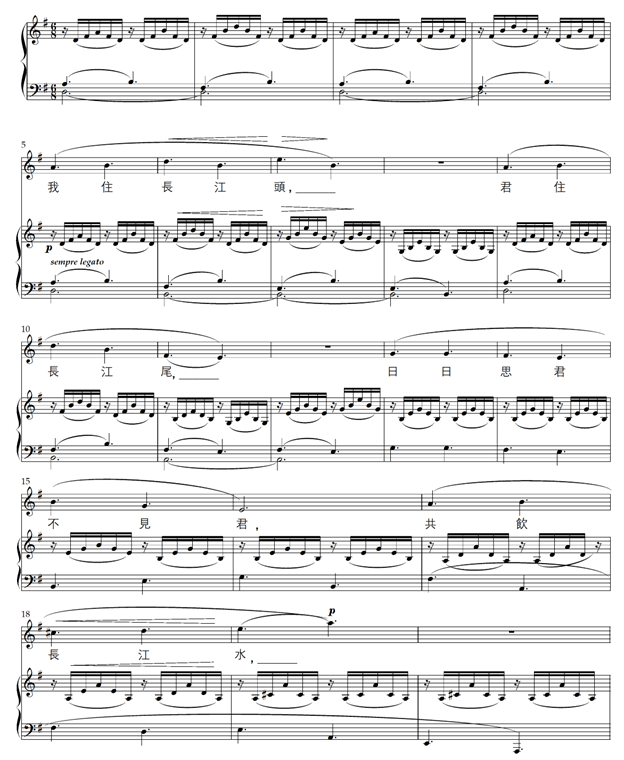
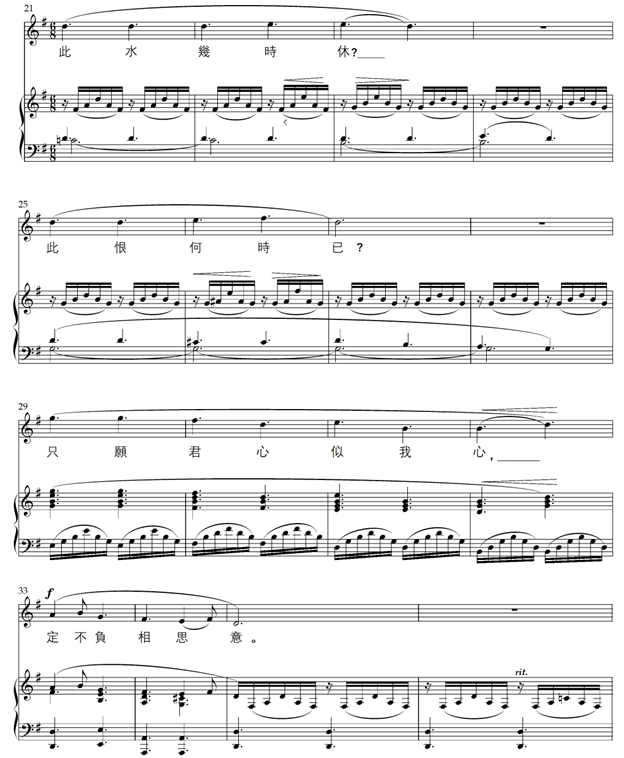
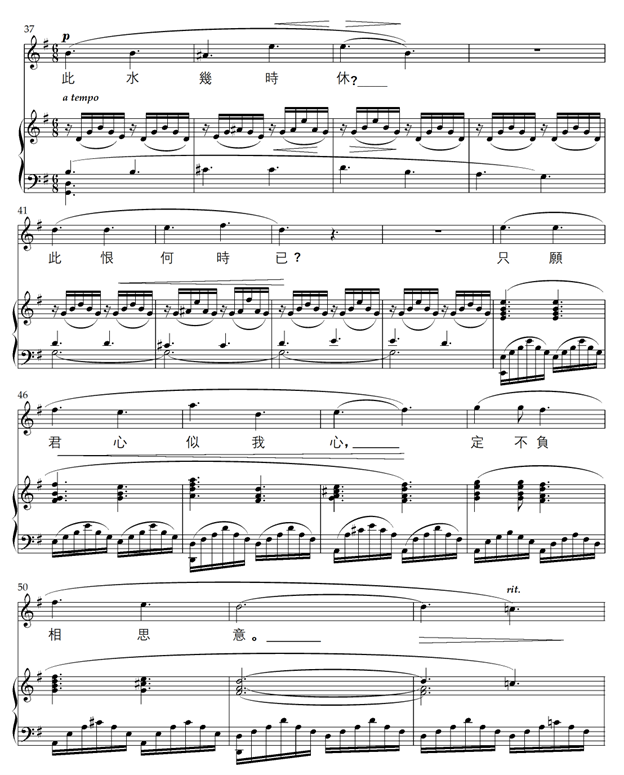
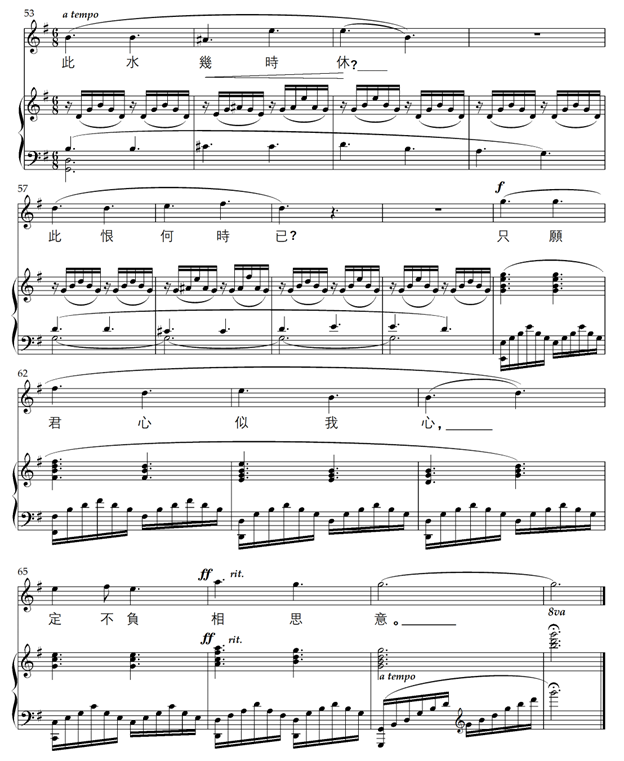
His love for music and language resulted in song compositions. His New Poetry Songbook (Xin shi ge ji 新詩歌集), a collection of fourteen settings of modern vernacular poems,was published in Shanghai in 1928 and reprinted in Taiwan in 1960.[2] In the preface and introduction, Zhao described to the cultural environment surrounding the creation of these songs. He also explicitly explained—to a new audience—the structures and styles of the works.
He traced the lineage of the songs in the collection to the “art songs” of Schubert and/or Schumann. Thus, solo voice with piano accompaniment would be the norm. As in Lieder, the piano parts had their own musical value. Zhao stipulated that the accompaniments of a few works could be played alone. The vocal parts were for all voice types and gender neutral.[3]
It is a common practice to transpose Lieder to the key most suitable for the voice of an individual performer. For convenience, most Lieder collections are published in three versions: for high, medium, and low voices. Zhao pointed out the impracticality of doing so for a limited market. He chose instead to set the music within a manageable range for most people. He also selected keys which could be easily transposed down a half step by the pianist. A quick lesson on this maneuver was given.
The question arose: Are Chinese art songs merely imitations of Lieder and melodies? In the introductory essays, Zhao carefully explored the evolution of the genre by first tracing the traditional relationship between words and music. Following is an analytical reading of his arguments:
__Recitation vs Singing
Melodious recitation of poetry had long been a tradition in China. Combinations of level and oblique tones—a crucial element of versification—shaped the melodic lines. Poems of the same tonal structure would be recited on the same tune. Tone patterns in jintishi 近體詩 (new style poetry) of the Tang Dynasty and ci of the Song Dynasty were highly regulated, following the standard classifications in rhyme dictionaries such as Qieyun 切韻 and Guangyun 廣韻.[4] Therefore, regional linguistic differences had limited impact on the recitation tunes. On the other hand, regional discrepancies were more apparent in recitations of gushi 古體詩 (old style poetry) and classical prose, as they were less regulated by standardized tone patterns.
Zhao commented that, even though there were basic melodic lines, due to each reciter’s inflections and his/her spontaneous modifications, the actual readings were rarely the same. While delineating the tone patterns, these recitative melodies did not convey the contents and expressions of individual poems.[5]
Preexisting melodies also played important roles in Chinese theater. Two melodic prototypes, namely xipi 西皮and erhuang 二黃—known together as pi-huang 皮黃, were the backbones of traditional theater, such as Peking opera, Guangdong opera and many other regional theaters.[6] Although each opera was notated in gongche notation 工尺譜,[7] without the texts, the melodic similarities would have made it impossible for the audiences to tell the operas apart. Zhao implied that, if not for the rhythmic patterns, the actors would have been “reciting the operas” instead of “singing the operas.”
Richer melodic materials could be found in folk songs. However, the same tune would be used for multiple verses. Good tunes were often “borrowed” to fit new texts. While the melodies were distinguishable from each other, they still did not fully support the poetic details. Contrary to the practice of fitting words into a generic tune, art songs were written specifically to reflect the linguistic and emotional features of each poem.
To clarify, Zhao compared two music settings of “Die Loreley” by Heinrich Heine (1797-1856): The strophic song by Friedrich Silcher (1789-1860) and the durchkomponiert (through-composed) setting by Franz Liszt (1811-1886).[8] The former had been popularized into a folk song in which the melodic theme was repeated several times in each of the three stanzas. In the latter, each section of the poem had different melodic lines supported by piano accompaniments, depicting the scenery, and shaping the dramatic details. Zhao elucidated that, when appropriate, musical repetitions were still found in through-composed songs.
__Poetry vs Songs
Without fixed tone patterns, modern poems could not be recited in the traditional manner. Art song settings, especially the through-composed approach, seemed to be a more suitable way to deliver their structures and contents. Would these poems benefit from the music?
Zhao believed that vernacular poems were best read aloud with proper inflections and expressions. Tonal fluctuations in the spoken words were subtle. No matter how the composers tried to match the pitches (gong-che 工尺) with tone levels (píng-zè 平仄), the suppleness of the inflections could be lost.[9] Sometimes, this could make certain words difficult to understand or it could affect the clarity of the texts. Musical rhythms, however rubato, were more regulated than speech rhythms. Unavoidably, some words would be elongated artificially.
Despite the possibility of being detrimental to the clarity and the expressiveness of poems, musical settings offered additional interest to the presentation. Good singing could enhance the overall aesthetic—this should have been the raison d’être of art songs.
Unless the poet intended for the poem to be used as lyrics, he did not have to consider whether the work would be suitable for singing. On the other hand, it would be necessary for the composer to select texts for musical settings. Zhao suggested the following selection criteria:
•Words with sonorous tones
•Organized phrasal structure
•Easy to comprehend
•Rhyming clauses
•Repetitions
•Declamatory clauses
Literary works and musical compositions derived from them were independent of each other. For example: Shakespeare’s Midsummer Night’s Dream and Mendelssohn’s incidental music for the play, or Goethe’s Faust and Gounod’s opera were separate entities with their own artistic values. However, matching captivating music with enthralling poetry, while reducing some effects from either side, could still achieve exciting results. Thus, the saying of “words [marrying] music.”
__Chinese Music vs Western Music
Traditional Chinese music shares many similarities with its western counterparts:
•Solfege: The five tones in the pentatonic scale, gong, shang, jue, zhi, yu (宮商角徵羽) or, in gongche notation, shang che gong liu wu (上尺工六五) can be equated with do, re, mi, sol, la in western scales.[10]
•Rhythm: In Chinese music patterns are organized by bǎn (板)—strong beats, played on the clappers, and yǎn (眼)—weak beats, on the small drums. Yì-bǎn-san-yǎn (一板三眼 one ban-three yans) would be similar to 4/4 time in the western music.[11]
•Forms: In Chinese music, structural divisions can be marked as jia-yi-jia (甲乙甲), jia-yi-jia-bing (甲乙甲丙), etc., parallel to western forms, “ABA,” and “ABAC.”
Discrepancies are more noticeable in other areas, such as ornaments and portamenti. Chinese ornaments—huayin (花音, flowering tones) should be sung quickly but smoothly, while the western practice emphasizes the precision and clarity of these notes. Portamenti are frequently used in Chinese music, both instrumental and vocal. In western practice, sliding tones are used discreetly.
Since ancient time, Chinese music has been governed by the shí-èr-lǜ (十二律), a twelve-tone temperament similar to the Pythagorean system, using the 3:2 frequency-ratio to create intervals of pure fifths.[12] Instead of forming a chromatic scale—as in the western practice, the twelve tones were used as the foundation (tonic) of individual scales. While the western practice favors heptatonic scales, the Chinese melodies are mostly built upon pentatonic scales.
Some instruments are uniquely Chinese. For example, qin 琴 or guqin 古琴 (ancient qin): a seven-string fretless zither, known as the instrument of scholars and intellectual elites. In addition to the seven open-string sounds, there are ninety-one harmonics and one hundred forty-seven stopped sounds within its four-octave range. Its characteristic gliding stopped sounds are created by shifting the left hand. Extended melodic passages can be played on harmonic overtones.[13]
Zhao argued that, although Chinese music shared many fundamental elements with western music, it was lagging behind in its development:
•Western music had more rhythmic variations.
•There was greater diversity in western scale patterns, ranging from pentatonic scales, common in Scottish folk music, to twelve-tone series.
•Instead of remaining in one key throughout, most western pieces included frequent tonal changes.
•In addition to solo wind and string instruments, there were orchestral ensembles, and keyboard instruments, e.g., pipe organs with four manuals and pedals.
•There were small pieces in ABA form as well as works in extended format, such as sonata form.
•Other than monophonic melodies, there were homophonic and polyphonic textures in western music.
Zhao believed that allowing the musical commonality to supersede national characteristics enabled the advancement of the western tradition. He encouraged Chinese readers/audiences to be open minded and through appreciation of world music to search for the path of Chinese music development.
Using Russian music as an example, he suggested that it would be possible to combine universal musical elements with national characteristics as well as the personal approach of the composers. Huayin and portamenti could be used as much as desired, seven-string qin could be further explored as long as Chinese music making could reach the level the world standard.
__Works in New Poetry Songbook
Rather than describing individual works in the collection, Zhao explained his general approach to art song composition. He considered the implication of harmony a key issue in the development of Chinese music. Even though there could be infinite variations of monophonic melodies, the results were horizontal and one-dimensional. Harmonies would create a two-dimensional infinity. Harmonies would enable key changes, essential to the tonal structure of western music.
Since harmonic progressions did not exist in traditional Chinese music, it would be necessary to borrow the western rules. Nevertheless, these rules could be modified to enhance the “Chinese sounds.” Brief passages of parallel fifth and pentatonic voice leading were among the possible options. Composers such as Debussy and Borodin had previously experimented with these techniques.
Melodically, there were more opportunities to bring in Chinese characters. Zhao, in addition to using ornaments to imitate the traditional singing styles, also adopted old-fashioned recitatives and theatrical passages. He explained to the readers/musicians how his melodic writings evolved gradually from pure western style to almost entirely Chinese.
Finally, and most crucially, Zhao delved into matching the linguistic tones with melody. Poetic meter, combinations of stress and non-stressed syllables, played an important part in setting western texts. While in Chinese songs, the word-tones must be handled properly.
Zhao suggested that there could be two different approaches: One would be to fix the four tones to one or a few given pitches. [14] The other one would be to allow a wider range of suitable options. The former would limit melodic creativities. Hence, the latter would be a desirable choice.
The four tones in modern Chinese were yīnpíng (陰平, the level tone), yángpíng (陽平, the rising tone), shàng (上, the falling-rising tone), and qù (去, the falling tone). On the other hand, the Middle Chinese tones, used in rhyme dictionaries, were level tone píng (平) and oblique tones, shǎng (上, rising), qù (去, departing or falling), and rù (入, entering or checked).[15] Different readings of the same words could result in different melodic handlings. Zhao preferred to observe the traditional level and oblique divisions. Following were his approach in general:
•Set level-tone words syllabically—preferably on do, mi, sol.[16] When setting a word/syllable to multiple notes, start with higher pitches. Ornaments did not have to follow this practice.
•Use multiple notes for oblique-tone words. It would be possible, but not necessary, to use re, fa, la,and ti.
•When level and oblique tones were linked together, use lower pitch for level-tone words.
•Only important words, especially rhymed words, were restricted by the above-mentioned rules. Other words could be set freely.
•The four above-mentioned rules were suitable for regular song [texts]. For songs of realistic or comic characters, it would be possible to observe the modern tone divisions or to combine the two approaches.
New Poetry Songbook was published at a time when music engraving equipment was not readily available in China. In addition to staff notation, the vocal lines of all the pieces were also presented in numbered notation, commonly used for school songs.[17] Zhao Yuanren self-deprecatingly used the word scherzando to describe his song collections. While being thorough and clear with his explanations, his wording was casual and down-to-earth. However, his eagerness to broaden the horizon of the general public was apparent.
Alarmingly, he rebuked the idea that “real Chinese music” must use solely peculiar things such as parallel fourths or fifths, natural minor[18] or pentatonic scales. To him, this misconception was rooted in “Museum Chinese”—something “picturesque” or “quaint” that would stir up curiosity but not true love or care:
. . .We Chinese must live normal human lives in China. We, the entire country, cannot be dressed in costumes from anthropology museums, readying especially for you to visit. China is not Chinatown in San Francisco. . ..
. . .我們中國的人得要在中國過人生常態的日子, 我們不能全國人一生一世穿了人種學博物院的服裝, 專預備著你們來參觀. 中國不是舊金山的中國市. . ..
Decades later, preparing for the reprint, Zhao held firmly to his convictions.
[1] Born and raised in southeastern China, Zhou was fluent in many Wu dialects. He spoke Japanese, English, German, French and Spanish. He was also knowledgeable in Greek, Latin and Russian.
[2] The first section of “Bouquets in the Vase” 瓶花, the last song in the collection, was set to a poem of the same title by Fan Chengda 范成大 of the Song Dynasty.
[3] Zhao suggested that 《勞動歌》 (”Laboring Song,”1922)would sound more convivial sung by a choir. 《海韻》(“Melody of the Sea,” 1927), the last piece in the collection, was written for mix-voice choir with soprano solo.
[4] Chinese Poetry (VII) Tang Poetry/Goldfish Odyssey
Chinese Poetry (IX): ci/Goldfish Odyssey
Regulated_verse_Wiki, ci_poetry_Wiki,
Qieyun_Wiki, Guangyun_Wiki
[5] 李白_兩首_趙元任教授吟誦_YouTube: Recording of Zhao reciting two poems by Li Bai in Changzhou dialect.
[6] Characteristics of xipi include leaps of large intervals, higher register, and vivid rhythms. Erhuang, on the other hand, has smooth melodic lines, lower range, and calmer rhythmic gestures. For each tune, there was a basic version in moderate tempo called yuanban 原板 (“original rhythm”). Variants with different speed and melodic modifications were used to enhance the dramatic intensities. Actors would often modify the music to deliver emotional details.
[7] Gongche_notation_Wiki
[8]The poem was written in 1824. Silcher’s set it to music in 1837. There were two versions by Liszt. The first one was written in 1841; the second between 1854 and 1856. Zhao did not specify which version was used in his study.
[9] “. . . 唱歌總是定音多, 滑音少, 不能像天然語調那麼定音少滑音多. . ..”
“. . . There are always more definite pitch(es) and fewer sliding pitch(es) in singing, unlike natural linguistic inflections with fewer definite pitches but more sliding ones. . ..”
[10] In practice symbols 凡 乙 were used for fa and ti.
[11] Yì-bǎn-yì-yǎn 一板一眼—one strong beat and one weak beat—is the equivalence of duple meter in western music. As an idiom, the term means following the regulation without wavering or extremely organized.
[12]shí-èr-lǜ_Wiki. The names of the twelve tones are:
Huáng Zhōng 黃鐘, Dà Lǚ 大呂, Tài Cù 太簇, Jiá Zhōng 夾鐘, Gū Xiǎn 姑洗, Zhòng Lǚ 仲呂, Ruí Bīn 蕤賓, Lín Zhōng 林鐘, Yí Zé 夷則, Nán Lǚ 南呂, Wú Yì 無射, Yìng Zhōng 應鐘. Explanations of the system were found in documents from the Waring States period (475–221 BC). The exact pitches changed throughout the history.
[13] Guqin_Wiki
[14] Zhao devised a five-tone diagram—based on the five-line western musical staff—to distinguish the four tones in Mandarin Chinese. Tone_letter#Chao_tone_letters_(IPA)_Wiki
[15] Four_tones_(Middle_Chinese)_Wiki
[16] Zhao seemed to use the words 平音 “leveled pitch(es)” to mean “single [unchanged] note.”
[17] Numbered_musical_notation_Wiki
[18] Without standard translations for western music terminology, Zhao often devised his own Chinese versions. Here, he used the words 平七度小調. Word for word translation would have been “flat-seven-degree minor scale(s).” Since the seventh were usually raised in harmonic or melodic (ascending) minors, I thus translated the phrase as “natural minor scales.”